
🕮13 min read · 2,572 words
AI agentic editors have fundamentally changed how software gets written. Tools like Cursor, GitHub Copilot, Windsurf, and Claude Code don’t just autocomplete lines — they write entire functions, scaffold full features, generate database migrations, wire up API endpoints, and in some cases build significant portions of an application from a single prompt.
The speed is real. A task that previously took a senior developer two hours can be scaffolded in ten minutes. For small teams and solo developers, this is genuinely transformative.
But there’s a problem that doesn’t get discussed enough in the excitement around agentic coding tools: the code they produce is often subtly wrong in ways that don’t surface immediately. Not wrong in the sense that tests fail or the application crashes — wrong in the sense that business logic is misunderstood, security boundaries are missing, performance will degrade under real load, and code quality is inconsistent in ways that will slow your team down for months.
This is where code auditing becomes essential — not as a bureaucratic quality gate, but as a practical tool for finding and fixing what AI gets wrong before it becomes expensive to address.
This post is the first in a series covering each audit type in depth. Here we’ll cover why AI-generated code specifically needs auditing, what the different types of audits are and what each one finds, and how to build auditing into your development workflow rather than treating it as a one-off exercise.
Why AI Agentic Editors Create a Specific Auditing Problem
Traditional code review assumes that a human wrote the code — which means the reviewer is looking for human mistakes: logic errors, overlooked edge cases, style inconsistencies, the occasional copy-paste bug. The assumption is that the developer understood what they were building; the review catches cases where they executed it imperfectly.
AI-generated code breaks this assumption in a fundamental way. The AI doesn’t understand your business. It doesn’t know that a specific field is financially sensitive, that a particular workflow has regulatory implications, that the pattern it chose will cause N+1 query problems at scale, or that the authentication approach it generated doesn’t match how your application handles permissions elsewhere.
The AI is pattern-matching against its training data and generating code that looks correct for the prompt it was given. It has no awareness of the wider context — your data model, your business rules, your existing architecture decisions, your security posture, your performance requirements. It produces code that solves the immediate problem as stated, in isolation, without understanding what surrounds it.
This creates a different category of code review problem. You’re not just looking for execution errors — you’re looking for context errors. Code that works correctly in isolation but is wrong in the context of your specific application. These errors are harder to spot in standard code review because the code looks clean, runs without errors, and passes functional tests. The problems only become visible when you step back and ask whether the code does the right thing in the context of your whole system.
Compounding this, AI agentic editors work fast — which means code volume increases significantly. More code produced faster means more surface area to review with the same or fewer human reviewers. The combination of higher volume and a new category of context errors is what makes structured auditing — not just ad hoc code review — necessary when working with agentic tools.
What Happens Without Audits — Real Examples
Before covering the audit types, it’s worth being concrete about what goes wrong when AI-generated code isn’t properly audited. These aren’t hypothetical scenarios.
A developer uses Cursor to scaffold a Laravel REST API for a client management system. The AI generates clean, well-structured controllers and routes. Standard code review passes them because the code looks professional. Three months after launch, a penetration test reveals that any authenticated user can access any other user’s client records by changing the ID in the URL — the AI generated endpoints without ownership checks because the prompt didn’t specify them and the reviewer didn’t think to look.
A team uses Claude Code to build a reporting feature that queries order history. The AI generates working queries that return correct results in development with 500 test records. In production with 2 million records, the same queries take 45 seconds and time out for most users. The AI chose an approach that worked for the prompt but didn’t account for scale — and nobody ran a performance audit before launch.
A solo developer uses GitHub Copilot to build a discount calculation system for an ecommerce application. The AI implements the logic based on the examples in the prompt. The logic works for the test cases but mishandles a specific combination of discount types that the developer didn’t think to test — a business logic error that results in orders being significantly undercharged for two weeks before anyone notices.
In each case, a structured audit would have caught the problem before it reached production. Standard code review didn’t catch them because standard code review wasn’t designed for the specific failure modes of AI-generated code.
The Six Core Audit Types — Overview
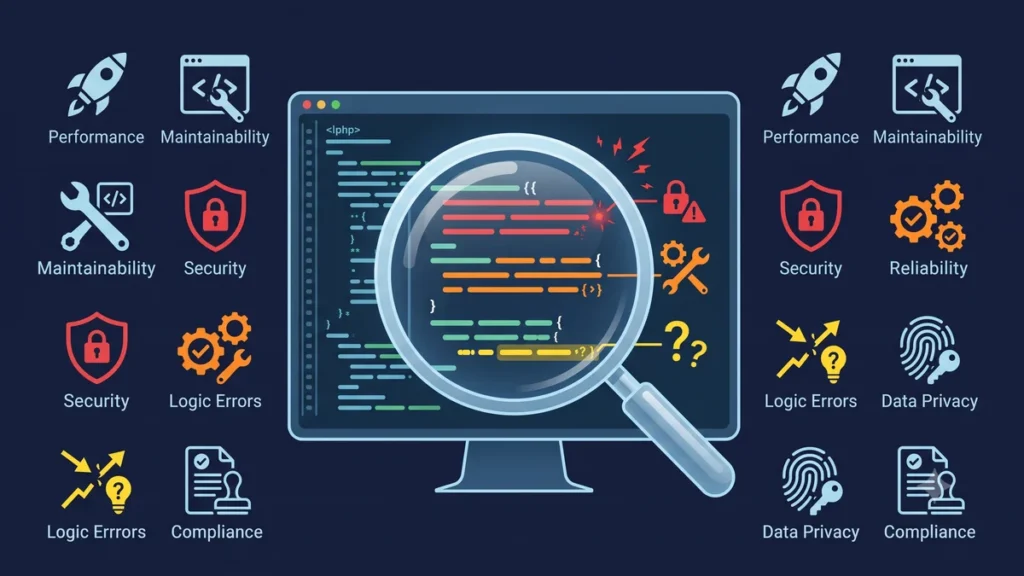
When we audit AI-generated codebases at Softcrony, we run six distinct types of audit — each looking for a different category of problem. These aren’t sequential stages; they’re parallel lenses applied to the same codebase. Some can be partially automated; others require careful human analysis. All six are necessary for a complete picture.
Business Logic Audit — Does the code actually implement the right rules? AI generates code that solves the stated problem, but business rules are complex, interdependent, and full of edge cases that prompts rarely capture fully. A business logic audit examines whether the application’s behaviour matches what the business actually requires — not just whether the code runs. This is the hardest audit to automate because it requires understanding the business, not just the code.
Security Audit — Does the code introduce vulnerabilities? AI-generated code has consistent, well-documented security failure patterns — missing authorisation checks, SQL injection via string interpolation, insecure file handling, exposed sensitive data in API responses, missing rate limiting, hardcoded credentials. A security audit systematically checks for these patterns across the codebase, going beyond what automated scanners catch to include logic-level vulnerabilities that tools can’t detect.
Code Quality Audit — Is the code maintainable, consistent, and correctly structured? AI agentic editors produce code in whatever style fits the prompt — which means inconsistent naming conventions, duplicated logic, inappropriate abstractions, violations of the project’s architecture patterns, and code that works today but will be difficult to modify tomorrow. A code quality audit identifies technical debt introduced by AI generation before it accumulates to the point where it slows the team significantly.
Performance Audit — Will the code perform adequately under real conditions? AI generates code that works on development data. It doesn’t automatically choose the most performant approach, add appropriate database indexes, avoid N+1 query patterns, implement caching where it’s needed, or optimise for the data volumes and concurrent user loads of production. A performance audit identifies these problems before they affect real users.
Database Audit — Is the data layer correctly designed and safely implemented? AI-generated database schemas, migrations, and queries frequently have problems that aren’t visible in functional testing — missing indexes on queried columns, inappropriate data types, absent foreign key constraints, queries that scan full tables, schema decisions that will require expensive migrations later. A database audit examines the data layer specifically, separate from the application code above it.
Architecture Audit — Does the code fit correctly into the overall system? AI generates code in response to prompts — which means it makes local decisions without awareness of global architecture. It might implement a pattern in one part of the application that contradicts how similar problems are solved elsewhere, introduce a dependency that conflicts with the project’s dependency management approach, or structure a module in a way that creates tight coupling that will cause problems as the application grows. An architecture audit looks at whether AI-generated additions are coherent with the overall system design.
When to Run Each Type of Audit
Not all audits need to happen at the same frequency or at the same points in development. Here’s a practical cadence that works for teams actively using AI agentic editors.
Continuously — automated checks in CI pipeline
Static analysis tools running on every pull request catch the pattern-based problems that don’t require human judgment — known vulnerability patterns, code style violations, obvious quality issues, dependency vulnerabilities. Tools like PHPStan, Psalm, and Enlightn for Laravel/PHP projects; ESLint with security plugins for JavaScript; Bandit for Python. These run automatically and block merging when they find critical issues. They don’t replace human audits but catch the mechanical problems before human reviewers spend time on them.
Per feature — before merging significant AI-generated code
Any time an AI agentic editor has generated a significant portion of a feature — more than a few functions, any authentication or authorisation code, any financial calculation, any file handling, any new API endpoints — a targeted review covering business logic, security, and the most relevant performance considerations should happen before the code merges to the main branch. This doesn’t need to be a full audit of the entire codebase — just the new code and its immediate context.
Monthly — code quality and architecture review
Technical debt accumulates gradually. A monthly review of code quality and architectural coherence catches drift before it becomes entrenched. This is where you identify patterns that are consistently problematic in AI-generated code for your specific project — duplicated logic, inconsistent abstractions, growing modules that should be split — and address them before they compound.
Before major releases — full audit cycle
Before launching a new version to production, especially one that includes significant AI-generated code, running the full set of audits provides confidence that the release is solid. This is when the database audit is most important — schema decisions that need to change are cheapest to change before they’re in production with real data. Security audit at this point should be comprehensive, not just pattern-based.
Quarterly — architecture and full codebase audit
A complete audit of the full codebase, looking at architectural coherence, accumulated technical debt, security posture across the whole system, and performance characteristics under projected load. This is the most time-intensive audit type but provides the clearest picture of overall codebase health and where investment in cleanup will have the most impact.
How to Use AI to Help With Its Own Auditing
One of the most practically useful aspects of working with AI agentic editors is that you can use them to help audit their own output — with important caveats about what they can and can’t catch.
AI is genuinely useful for pattern-based audit tasks — reviewing code for known vulnerability patterns, checking that validation is applied consistently, identifying duplicated logic, reviewing database queries for common performance antipatterns. These are tasks where the AI has clear patterns to match against and the context is local rather than global.
A useful prompt pattern for security-focused review:
Review this code for security vulnerabilities.
Check specifically for:
- Missing authorisation checks (can any authenticated user access data they shouldn't?)
- SQL injection risks (any string interpolation in queries?)
- Missing input validation (any user input reaching the database or filesystem unvalidated?)
- Exposed sensitive data (any fields in API responses that shouldn't be public?)
- Missing rate limiting (any endpoints that could be brute-forced?)

For each issue found, explain the risk and provide the corrected code.

[paste code here]
For business logic review, provide the AI with both the code and the business requirements, then ask it to identify discrepancies:
Here are the business rules for our discount system:
[paste requirements]

Here is the implementation:
[paste code]

Identify any cases where the implementation doesn't match the business rules,
including edge cases that the requirements mention but the code doesn't handle.
List each discrepancy with the specific rule it violates and the corrected implementation.
The important caveat: AI auditing of AI-generated code is useful for catching pattern-based and local-context problems. It is not reliable for catching architectural problems, for understanding your specific business domain deeply enough to catch business logic errors, or for identifying issues that require understanding how components interact across the whole system. Human judgment remains essential for these categories.
Building Audit Into Your Workflow — Practical Steps
The teams that get the most value from auditing AI-generated code are the ones that treat it as a workflow component rather than an occasional exercise. Here’s how to structure that.
Define your audit checklist per feature type. Authentication code gets checked for specific things. Financial calculations get checked for different things. File handling gets checked for yet another set. Rather than doing a generic review, having a feature-type-specific checklist ensures that the most important checks for each category of code are never missed. Build these checklists from the specific failure patterns you’ve seen AI generate in your projects.
Make the AI declare its assumptions. Before reviewing AI-generated code, ask the AI to explain the key assumptions it made — about data types, about who has access, about error conditions, about scale. These declared assumptions are the starting point for your audit. Every assumption that’s wrong is a potential bug.
Test with adversarial inputs, not just happy path. AI-generated code is typically tested against the inputs described in the prompt — the happy path. Auditing includes testing with inputs the AI didn’t anticipate: empty values, extremely large values, unexpected formats, values from different user roles, concurrent requests, values at boundary conditions. These are where the gaps between what was prompted and what was needed become visible.
Document what you find and fix. The patterns that AI gets wrong in your codebase are often consistent — the same types of errors appearing in different features. Documenting these patterns builds a project-specific audit guide that makes subsequent audits faster and more targeted. It also informs how you write prompts going forward — knowing that AI consistently misses ownership checks means you explicitly include them in every relevant prompt.
What Each Audit Post in This Series Will Cover
This post is the foundation. The remaining posts in this series go deep on each audit type — specific patterns to look for, practical checklists, real code examples of problems and fixes, and tools that help automate the mechanical parts.
Coming next in the series:
- Business Logic Audit — How to verify that AI-generated code implements your actual business rules, including edge cases the AI didn’t anticipate
- Security Audit — A systematic checklist for the specific vulnerabilities AI agentic editors introduce most frequently
- Code Quality Audit — How to identify and address the technical debt that accumulates when AI generates inconsistent code at speed
- Performance Audit — Finding the N+1 queries, missing indexes, and scaling problems before they affect real users
- Database Audit — Reviewing AI-generated schemas, migrations, and queries for correctness, safety, and long-term maintainability
If you’re building with AI agentic editors and want a structured audit of your codebase — to understand what’s solid, what needs attention, and what’s a risk that should be addressed before it reaches production — our team at Softcrony is happy to help. We work with development teams building on Laravel, React, and modern stacks to make AI-assisted development both fast and trustworthy.
Read each audit in depth:
- Business Logic Audit — catching what AI gets wrong in your business rules
- Security Audit — the systematic checklist for AI-introduced vulnerabilities
- Code Quality Audit — cleaning up the technical debt AI leaves behind
- Performance Audit — finding hidden bottlenecks before they hit production
- Database Audit — schema, migrations, and queries reviewed completely
Leave a comment