
🕮11 min read · 2,180 words
Most software products that fail don’t fail because the technology was wrong. They fail because too much was built before anyone confirmed that real users actually wanted it. The MVP — minimum viable product — exists to solve this problem. But the concept is so widely misunderstood that most MVPs don’t actually solve it.
This guide is for founders, product managers, and business owners who are serious about building an MVP that validates something real, not just a stripped-down version of a product nobody asked for.
What MVP Actually Means — And What It Doesn’t
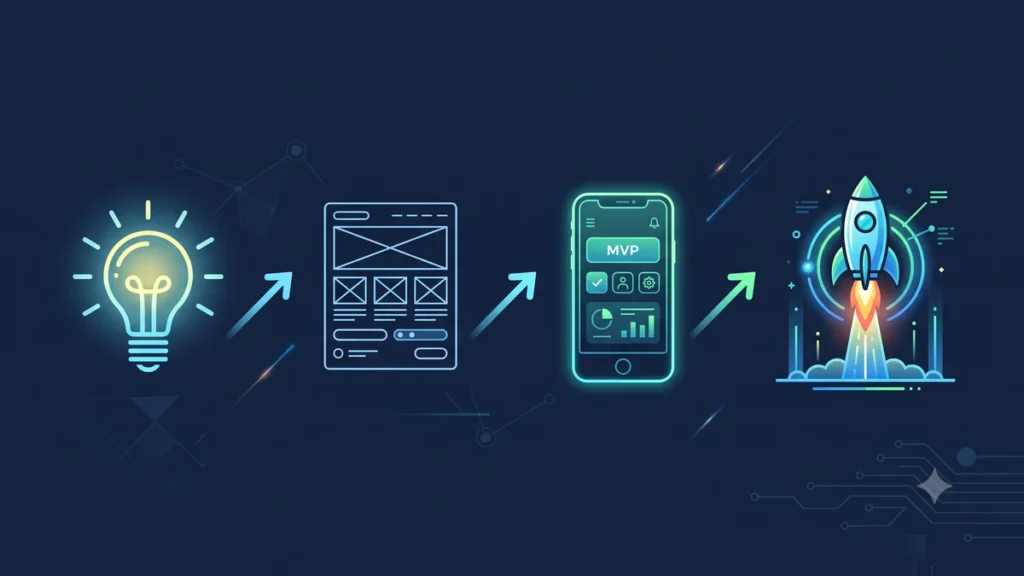
The term “minimum viable product” comes from Eric Ries and the Lean Startup methodology. The operative word that people misunderstand is “viable.” An MVP is not a half-built product. It’s not a prototype. It’s not a demo. It’s the smallest version of a product that delivers enough value to real users that you can observe genuine behaviour, collect meaningful feedback, and make informed decisions about what to build next.
The “minimum” part is about scope — doing less than you originally planned. The “viable” part is the constraint on how far you can strip it back. An MVP that doesn’t actually solve the user’s problem isn’t minimum viable — it’s just minimum. And minimum without viable teaches you nothing useful.
This distinction matters enormously in practice. A common mistake is building an MVP that’s so reduced it doesn’t represent the actual value proposition of the product. Users interact with it, find it underwhelming, and the founders conclude the market doesn’t want what they’re building — when the actual problem is that they didn’t build enough of it to show what it could do.
The right question to ask when scoping an MVP is not “what can we cut?” but “what is the smallest version of this product that would make a real user say yes, this solves my problem?”
Before You Build Anything — Validate the Problem First
The most expensive mistake in MVP development is building before validating that the problem you’re solving is real, frequent, and painful enough that people will pay to have it solved. This sounds obvious. It’s routinely skipped.
Problem validation doesn’t require code. It requires conversations — direct conversations with the people you believe have the problem you’re solving. Not surveys. Not forms. Real conversations where you listen to how they currently handle the problem, how much it costs them, how often it happens, and what they’ve already tried.
If you can’t find twenty people who clearly have the problem you’re solving and can describe it in their own words without you prompting them, you’re not ready to build. Find those twenty people first. Their language, their frustrations, and their current workarounds will shape your MVP more usefully than any product planning exercise.
The signal you’re looking for is consistent, unprompted pain. If people describe the problem enthusiastically and without prompting — if they say “yes, this is a real issue, we deal with it every week” — that’s validation. If you find yourself explaining the problem to them and they politely agree it sounds interesting, that’s not validation. That’s politeness.
How to Define the Right MVP Scope
Once you’ve validated the problem, the scope definition is the most critical decision in the project. Get this wrong and you’ll either build too much — wasting time and money on features nobody uses — or too little — building something that doesn’t actually solve the problem you validated.
Start with the core user journey. Map the single most important thing your user needs to accomplish with your product — the one action that delivers the primary value. Everything else is secondary. Your MVP is built around making that one journey work flawlessly, even if everything else is manual, ugly, or missing entirely.
A useful exercise is the “concierge MVP” test — can you deliver the core value proposition manually, without software, to a small group of early users? If yes, do that first. Charge for it. If people pay for the manual version, you’ve validated willingness to pay before writing a single line of code. The software then becomes a way to scale what you’ve already proven works.
When defining feature scope, categorise every feature idea into three buckets. Must-have: without this, the product cannot deliver its core value proposition at all. Should-have: this significantly improves the experience but the product works without it. Nice-to-have: this would be pleasant but doesn’t affect core value. Your MVP contains only the must-haves. Everything else waits until you’ve validated the core.
The features that feel essential in a planning room almost never are. The features that turn out to be essential are usually discovered after real users interact with the product. Scope your MVP tightly, launch it, and let user behaviour tell you what to build next.
Choosing the Right Technology Stack for Your MVP
Technology decisions at the MVP stage are frequently over-engineered. Founders spend weeks debating microservices architecture, database choices, and infrastructure decisions that will be completely irrelevant at the scale of an MVP. This is a significant waste of time and money.
The right technology stack for an MVP has three properties: your development team knows it well, it can be built and deployed quickly, and it won’t create fundamental architectural problems if the product takes off. That third property is the only one that requires careful thought at MVP stage — you don’t need to build for scale, but you shouldn’t make choices that are impossible to undo later.
For most web-based MVP products, a Laravel or Node.js backend with a React frontend is a sensible default — mature ecosystems, good developer availability, plenty of hosting options, and a clear path to scaling. For mobile MVPs, React Native gives you iOS and Android from a single codebase, which significantly reduces development time and cost at the validation stage. Flutter is a strong alternative for teams with Flutter experience.
Avoid the temptation to build custom infrastructure, custom authentication systems, or highly optimised database schemas at MVP stage. Use managed services — AWS, Google Cloud, or DigitalOcean App Platform — for hosting. Use established auth libraries rather than building your own. Use Stripe for payments. Use Twilio for SMS. Use SendGrid for email. None of these are permanent decisions — they’re sensible defaults that let you focus development effort on the unique parts of your product rather than commoditised infrastructure.
The MVP Development Process — How It Actually Works
A well-run MVP development project follows a clear sequence that most teams either skip or compress in ways that create problems later.
Discovery and specification comes before any design or code. This is where you translate the validated problem and defined scope into a clear product specification — user stories, acceptance criteria, data model, API contracts, third-party integration requirements. Teams that skip this spend significantly more time in development as requirements change and clarify in real time. A week of proper discovery saves three to four weeks of development rework.
UI/UX design for an MVP should be fast and functional rather than polished. The goal is clear, intuitive user flows — not beautiful interfaces. Wireframes that clearly map the core user journey are more valuable at this stage than high-fidelity designs. Design polish comes after you’ve confirmed users will engage with the product. Many MVP teams skip design entirely and pay for it in development time and user confusion.
Development in short cycles is the standard approach — two-week sprints, each delivering a working increment of the product. This isn’t just an agile formality. It serves a real purpose: forcing regular evaluation of what’s been built against what was planned, catching misalignments early, and maintaining the ability to change direction without catastrophic rework. Teams that plan everything upfront and build for three months before showing anyone anything consistently build the wrong thing.
Testing at every stage is non-negotiable — not just at the end. Functional testing verifies that features work as specified. Integration testing ensures that components work together correctly. User acceptance testing — ideally with real target users rather than internal team members — validates that the product makes sense to someone who didn’t build it. Security testing ensures that basic vulnerabilities are addressed before launch. MVPs that skip testing in the name of speed consistently spend more time fixing post-launch problems than they saved by cutting testing short.
A controlled launch to a small, known group of target users is almost always better than a public launch. Start with twenty to fifty users who you’ve recruited from your problem validation interviews. People who already have the problem, already trust you enough to try your product, and are motivated to give you useful feedback. A small, engaged group of real users teaches you more in two weeks than thousands of sign-ups from a ProductHunt launch ever will.
What to Measure After Launch
The point of an MVP is learning. If you’re not measuring specific things after launch, you’re not learning — you’re guessing with slightly more data than before you launched.
Define your success metrics before you launch, not after. The exact metrics depend on your product, but they generally fall into a few categories. Activation: do users complete the core user journey after signing up? Retention: do users come back after their first session? A product that users try once and never return to has a fundamental value problem regardless of how many people sign up. Engagement: how often and how deeply are users using the core features? And for commercial products: are users willing to pay, and if so, how much?
The metric that matters most varies by product type. For a marketplace, it’s the percentage of supply-side listings that get matched with demand. For a SaaS tool, it’s day-30 retention. For an ecommerce product, it’s repeat purchase rate. Know your key metric before you launch and instrument your product to measure it accurately.
User interviews after launch are as important as quantitative metrics. Watching a user interact with your product for thirty minutes — where they hesitate, what they skip, what confuses them, what delights them — tells you things that no dashboard ever will. Plan for at least ten post-launch user interviews in the first month.
What MVP Development Costs — Honest Numbers
Cost varies significantly based on complexity, team composition, and geography. Here are honest ranges based on what MVP projects actually cost in 2026.
A simple MVP — web-based, single user type, core CRUD functionality, standard authentication, basic dashboard — built by an experienced Indian development team typically costs ₹3,00,000 to ₹8,00,000 and takes eight to fourteen weeks. This is the right range for a focused, well-scoped MVP with a clear core user journey.
A mid-complexity MVP — two user types with different roles, moderate business logic, third-party integrations (payment, maps, communication), mobile web or basic native mobile — typically costs ₹8,00,000 to ₹20,00,000 and takes twelve to twenty weeks.
A complex MVP — marketplace or multi-sided platform, real-time features, complex business logic, native mobile apps for both iOS and Android, significant third-party integrations — typically costs ₹20,00,000 to ₹50,00,000 and takes four to eight months.
These ranges assume a competent development team. The cheapest quotes in the market — freelancers or agencies with no track record — often produce MVPs that cost more to fix than to rebuild. The most expensive quotes — large agencies with heavy overheads — often produce over-engineered MVPs that take twice as long as necessary. The right choice is an experienced team with a demonstrable track record of shipping MVPs that actually launched and were used by real people.
The Mistakes That Kill Most MVPs
Building too much is the most common and most expensive mistake. Feature creep at the MVP stage is almost universal and almost always fatal. Every feature added to an MVP increases development time, increases testing complexity, delays launch, and reduces the clarity of what you’re actually testing. Ruthlessly cut scope. Then cut it again.
Not talking to users before building is the second most common mistake. Assumptions about what users want that are never tested against real users produce products that solve imaginary problems. The conversations are uncomfortable — nobody wants to hear that their idea needs rethinking — but they’re far less expensive than six months of development followed by a launch nobody uses.
Choosing the wrong co-founder or development partner is where many technically sound MVPs fail commercially. A founder without technical expertise who hands a vague idea to a development team without proper specification will get an expensive, wrong product. A development team without product experience that takes requirements at face value without challenging assumptions will build what was asked for rather than what was needed.
Waiting for perfection before launching is a mistake that kills MVPs that were otherwise well-built. The MVP is not your final product. It’s supposed to be imperfect. Launch when it’s good enough to test your core hypothesis — not when you’re proud of it. Pride is a post-MVP-validation luxury.
If you’re building an MVP and want an honest assessment of your scope, your technology approach, or your development plan, our team at Softcrony is happy to help. We’ve built MVPs across healthcare, logistics, fintech, ecommerce, and enterprise SaaS — and we’ll tell you honestly what your build needs and what it can wait until later.
Leave a comment