
🕮12 min read · 2,304 words
Most software development teams never use the Spiral model. They work in Agile sprints, or occasionally Waterfall, and the Spiral model is something they learned about in a university course and filed away as theoretical. That’s partly justified — the Spiral model is genuinely not the right choice for most projects. But for the specific types of projects it was designed for, it’s one of the most sensible approaches available.
Understanding what the Spiral model actually is, where it works, and where it doesn’t — beyond the textbook definition — is what this guide covers.
What the Spiral Model Actually Is
The Spiral model was proposed by Barry Boehm in 1986 as a response to the limitations of the Waterfall model for large, complex, high-risk software projects. The core insight was simple: on projects with significant uncertainty, the biggest risk isn’t writing bad code — it’s making wrong decisions early that become expensive to reverse later. The Spiral model puts risk management at the centre of the development process rather than treating it as a peripheral concern.
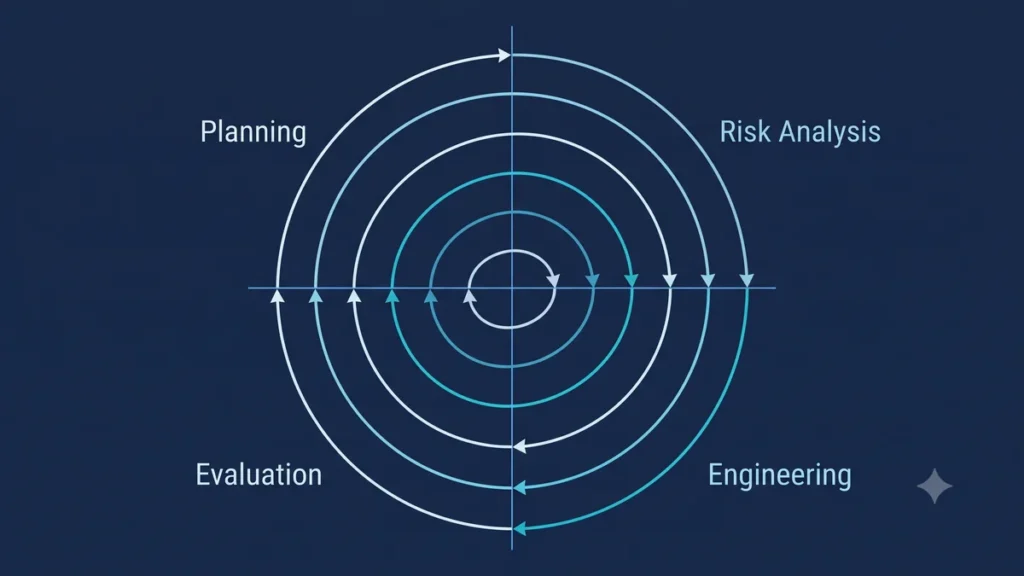
Structurally, the Spiral model organises development into repeated cycles — spirals — each of which passes through four quadrants: planning, risk analysis, engineering, and evaluation. Each completed spiral produces a working version of the software — or a prototype, or a proof of concept — that is evaluated before the next spiral begins. The number of spirals isn’t fixed in advance. It depends on how the project evolves, what risks are identified, and what decisions are made at each evaluation stage.
Visually, the model is often depicted as an actual spiral — each loop larger than the last, moving outward from the centre as the project grows in scope and the software grows in completeness. This isn’t just a diagram metaphor. It captures something real about how the model works: each cycle builds on the last, incorporates what was learned, and addresses risks that earlier cycles identified.
The Four Phases — What Actually Happens in Each
Understanding the model in practice requires knowing what each quadrant involves beyond the labels.
Planning at the start of each spiral isn’t a one-time requirements document. It’s a re-evaluation of objectives, constraints, and alternatives in light of what the previous spiral produced and what was learned from it. On the first spiral, this involves understanding the project goals, establishing constraints, and identifying alternative approaches. On subsequent spirals, it involves refining requirements based on actual feedback, adjusting scope based on risk findings, and updating estimates based on real progress. Planning in the Spiral model is continuous and responsive, not a document you produce once and refer to occasionally.
Risk analysis is the phase that distinguishes the Spiral model from everything else. At the start of every cycle, the team explicitly identifies the risks that could derail the project — technical risks, schedule risks, requirement risks, resource risks — and develops strategies to mitigate the most critical ones before moving forward. This might mean building a prototype to validate a technical assumption before committing to an architecture. It might mean conducting user research before finalising a feature set. It might mean a proof-of-concept integration with a legacy system before designing the full integration layer. The risk analysis phase forces the team to confront uncertainty explicitly rather than assuming it away.
Engineering is where actual development happens — design, coding, testing. The scope of this phase varies by spiral. Early spirals might produce only prototypes or proofs of concept. Later spirals produce production-ready increments. The engineering approach within each spiral can itself follow different methodologies — some teams use Waterfall-style sequential development within each spiral, others use short Agile sprints. The Spiral model doesn’t prescribe what happens inside the engineering phase, only that it happens within a spiral structure that begins with planning and risk analysis and ends with evaluation.
Evaluation closes each spiral. Stakeholders review what was produced, compare it against the objectives defined at the start of the spiral, collect feedback from users or internal reviewers, and make decisions about the next spiral — what to build, what to change, whether to continue, or in extreme cases whether to terminate the project. This last option is important: the Spiral model explicitly acknowledges that the right outcome of evaluation might be that the project shouldn’t continue in its current form. That’s not a failure of the model — it’s the model working correctly by surfacing a bad decision before more money is spent on it.
How the Spiral Model Differs from Agile and Waterfall
This comparison matters practically because teams choosing between methodologies need to understand where the boundaries actually lie.
The Waterfall model plans everything upfront, executes sequentially, and assumes that requirements are stable and well-understood from the start. It works when those assumptions are true — when you’re building something well-understood, with clear requirements, and low uncertainty. It fails badly when requirements change, when technical risks are high, or when the solution isn’t well understood at the start. The Spiral model was explicitly designed to address these failure modes.
Agile methodologies — Scrum, Kanban, XP — are iterative like the Spiral model but differ in a fundamental way: Agile is primarily optimised for speed and responsiveness to changing requirements, with risk management handled implicitly through short cycles and continuous feedback. The Spiral model is primarily optimised for explicit risk management, with iteration as a mechanism for risk reduction rather than an end in itself. Agile assumes you’ll discover problems through frequent releases. Spiral assumes you’ll identify and mitigate critical risks before committing to major development investments.
In practice, the Spiral model is often described as a meta-model — a framework within which you can use Agile or Waterfall for the engineering phase of each spiral, depending on what that spiral requires. This flexibility is one of its underappreciated strengths.
The Real Advantages — Beyond the Generic List
Risk is addressed before it becomes expensive. This is the Spiral model’s central contribution and it’s genuinely valuable on the right projects. A technical risk identified at the start of spiral two — before six months of development are committed to an architecture that won’t scale — is vastly cheaper to address than the same risk discovered in UAT. The explicit risk analysis phase forces teams to surface these problems early rather than discovering them late.
Requirements can evolve without project failure. On large, complex projects — enterprise systems, defence applications, healthcare platforms — requirements frequently change as stakeholders develop a clearer picture of what they actually need. The Spiral model’s iterative structure accommodates this evolution in a controlled way. Each spiral can incorporate requirement changes without the kind of catastrophic rework that requirement changes cause in Waterfall projects.
Stakeholders see working software early and often. Each spiral produces something tangible — a prototype, an increment, a proof of concept — that stakeholders can evaluate. This continuous visibility keeps stakeholders aligned with what’s being built, surfaces misunderstandings before they become expensive, and maintains confidence in the project’s direction. On large enterprise projects where stakeholder alignment is a constant challenge, this matters significantly.
The decision to continue is re-evaluated at each spiral. This sounds obvious but it’s genuinely valuable. On a Waterfall project, the decision to continue is made once at the start and rarely revisited seriously. On a Spiral project, each evaluation phase is an explicit decision point — continue as planned, change direction, scale back scope, or terminate. This structure creates natural stopping points where a rational cost-benefit assessment can be made, rather than the sunk-cost momentum that keeps many failing Waterfall projects alive long past the point where termination would have been the right decision.
Documentation is produced iteratively and stays current. Because each spiral involves planning and evaluation, documentation is updated continuously rather than written once upfront and allowed to drift out of sync with reality. On long, complex projects, this produces significantly more accurate and useful documentation than methodologies that front-load documentation production.
The Real Disadvantages — Also Beyond the Generic List
It requires genuinely skilled risk analysis. The Spiral model’s value depends entirely on the quality of the risk analysis performed at the start of each spiral. A team that goes through the motions — identifying obvious risks and treating them superficially — gets the overhead of the Spiral model without its benefits. Good risk analysis requires experience, domain knowledge, and the willingness to confront uncomfortable uncertainties honestly. These skills are less common than the ability to write code.
Cost and timeline estimation is genuinely difficult. Because the number of spirals isn’t fixed in advance and each spiral’s scope depends on the outcomes of the previous one, accurate upfront cost and timeline estimates are hard to produce. For projects with fixed budgets and hard deadlines — which is most commercial software projects — this is a serious practical problem. Stakeholders who need to commit budget and resources in advance struggle with a methodology that can’t confidently predict total cost or delivery date.
The overhead is significant for simple projects. Planning, risk analysis, engineering, and evaluation for every cycle adds process overhead that is unjustified for straightforward projects with clear requirements and low technical risk. Using the Spiral model to build a standard CRUD web application is like using surgical instruments to open a package — technically possible, but wildly disproportionate. The overhead that makes the model valuable on complex projects makes it actively counterproductive on simple ones.
It requires sustained stakeholder engagement. The evaluation phase of each spiral requires stakeholders to actively review what was produced, give meaningful feedback, and make informed decisions about the next phase. On projects where stakeholders are busy, disengaged, or unable to allocate the time this requires, the evaluation phase becomes a rubber stamp and the model loses much of its value.
Not many teams are experienced with it. Agile practitioners are abundant. Experienced Spiral model practitioners — people who can run genuine risk analysis sessions, facilitate productive evaluation phases, and manage the planning complexity of a multi-spiral project — are significantly rarer. Adopting the Spiral model with a team that has never worked with it adds a learning curve that should be factored into project planning.
When the Spiral Model Is Actually the Right Choice
Despite its limitations, there are specific project types where the Spiral model is genuinely superior to the alternatives.
Large, complex systems with unclear or evolving requirements — enterprise ERP implementations, national-scale government systems, complex healthcare platforms — where requirements cannot be fully specified upfront and where changing direction mid-project in a Waterfall model would be catastrophic. The Spiral model’s iterative structure absorbs requirement evolution without structural damage to the project.
High-risk research and development projects where significant technical uncertainty exists at the start. Whether a particular algorithmic approach will perform adequately at scale, whether a proposed integration with a legacy system is feasible, whether a specific AI model will produce acceptable accuracy — these are questions that need to be answered before committing to a full development investment. The Spiral model’s risk analysis and prototype phases address these questions explicitly.
Projects where the cost of failure is very high — safety-critical systems, financial infrastructure, defence applications, medical devices — and where the rigorous validation at each spiral boundary provides meaningful assurance that the project is on the right track before proceeding to the next level of investment.
Multi-year programmes where the full scope cannot be defined at the outset and where the product will evolve significantly as it’s built, validated, and deployed to early users. Each spiral provides a natural checkpoint for reassessing direction, adjusting scope, and making informed investment decisions about subsequent phases.
When Not to Use the Spiral Model
Small to medium projects with well-understood requirements and manageable technical risk — which is the majority of commercial software projects — are better served by Agile methodologies. The overhead of the Spiral model isn’t justified when the risks it manages are low and the requirements are clear enough for iterative Agile development to handle.
Projects with tight, fixed budgets and hard deadlines struggle with the Spiral model’s inherent planning uncertainty. If you need to commit to delivering a specific set of features by a specific date for a specific cost, Agile with a fixed scope or a well-managed Waterfall project is more predictable.
Teams without risk management expertise will get the overhead without the benefit. The Spiral model is only as good as the risk analysis that drives it. A team that hasn’t done this before should invest in learning Agile well before attempting the Spiral model.
The Practical Reality in 2026
Pure Spiral model implementations are relatively rare in commercial software development. What’s more common — and arguably more practical — is borrowing the Spiral model’s most valuable element (explicit, structured risk analysis at regular intervals) and incorporating it into an Agile or Waterfall process that the team is already comfortable with.
Running a risk analysis session at the start of each quarter on a large Agile programme. Building a prototype spiral at the start of a complex project to validate the most uncertain technical assumptions before committing to a full build. Using a structured evaluation checkpoint at the end of each major release before planning the next one. These are all Spiral model principles applied pragmatically without the full ceremonial overhead of a textbook Spiral implementation.
The Spiral model’s contribution to software engineering is less about the specific process structure and more about the insight that risk management should be a first-class concern in software development — not a footnote, not an assumption that things will be fine, but an explicit, structured activity that happens before significant commitments are made. That insight is valuable regardless of which methodology your team uses.
If you’re planning a complex software project and want an honest conversation about which development approach makes sense for your specific context — whether that’s Agile, a hybrid approach, or something more structured — our team at Softcrony is happy to help. We’ve delivered projects across multiple methodologies and will recommend the approach that fits your project, not the one that fits our process.
Leave a comment