
🕮11 min read · 2,159 words
At some point, almost every growing business hits the same wall. The software they’re using — whether it’s a spreadsheet, an off-the-shelf CRM, an accounting package, or an ERP they’ve outgrown — stops fitting how they actually work. They spend more time working around the software than working with it.
That’s usually when custom software comes up. And that’s usually when the questions start. What does it actually involve? How much does it cost? Is it really necessary, or is there an off-the-shelf tool we haven’t tried yet? How do we know if we’re making the right decision?
This guide answers those questions honestly — without overselling custom development or dismissing it. Because the right answer genuinely depends on your specific situation.
What Is Custom Software Development?
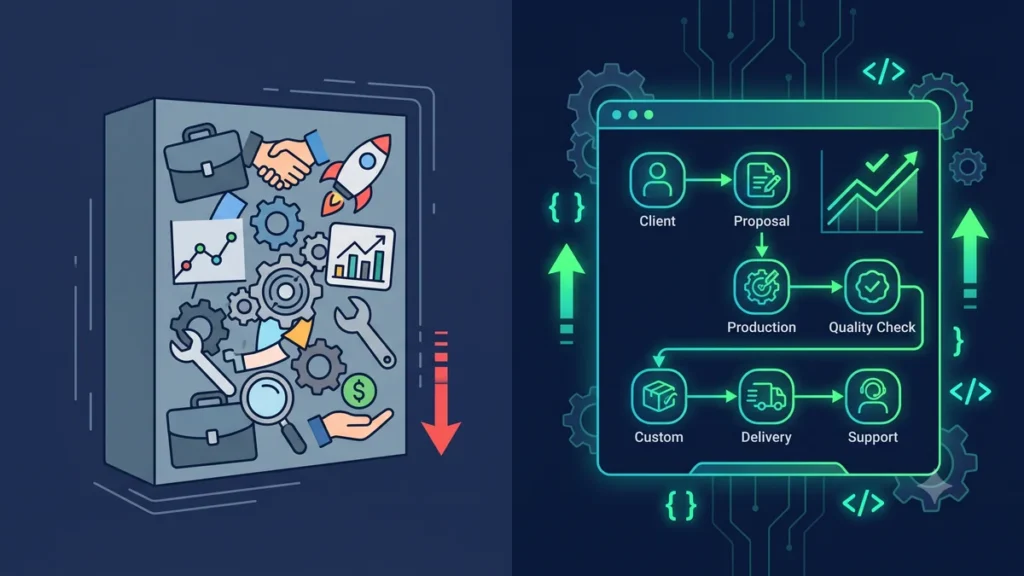
Custom software — also called bespoke software — is software built specifically for one organisation, to solve that organisation’s specific problems, the way that organisation actually works. Unlike off-the-shelf software that’s designed to work for as many businesses as possible, custom software is designed to work for one business as well as possible.
The scope varies enormously. Custom software might be a simple internal tool that automates one specific workflow — generating reports, processing a particular type of document, managing a niche operational process. Or it might be a full enterprise system — a custom ERP, a bespoke CRM, a logistics management platform, a customer-facing web application — that sits at the core of how the entire business operates.
What all custom software has in common is that it starts with your requirements, your processes, and your constraints — not with a vendor’s pre-built feature set that you try to configure to fit.
Custom Software vs Off-the-Shelf — The Honest Comparison
The decision between custom and off-the-shelf isn’t about which is better in general. It’s about which is better for your specific situation. Both have legitimate use cases, and choosing the wrong option in either direction is an expensive mistake.
Off-the-shelf software is the right choice when your use case is standard, the market has well-established tools that solve your problem, speed of deployment matters more than perfect fit, and your budget doesn’t support custom development. Accounting software, email marketing tools, project management platforms, basic CRMs — for standard use cases, mature off-the-shelf tools are often the right answer. They work on day one, they’re maintained by the vendor, and for common business functions they cover 80–90% of what most organisations need.
The problem starts when that 10–20% gap represents your most important business process. When the way you manage logistics, handle compliance, serve clients, or run operations is genuinely different from how the tool was designed to work. At that point, you’re either continuously working around the software’s limitations or you’re compromising on how your business operates to fit the software. Neither is acceptable long-term.
Custom software is the right choice when your process is genuinely unique, when off-the-shelf options require significant workarounds to function adequately, when integration requirements are complex, when data ownership and security requirements can’t be met by third-party platforms, or when the long-term economics of ongoing subscription costs versus a one-time build cost favour custom development.
The honest trade-off is this: off-the-shelf is cheaper and faster to start but may cost more in the long run through subscriptions, limitations, and workarounds. Custom is more expensive to build but gives you complete ownership and a system that fits your business exactly — and doesn’t charge you per user per month indefinitely.
What Custom Software Is Actually Built For
Custom software projects fall into a few recurring categories. Understanding which category your need falls into helps clarify whether custom is the right approach.
Process automation is one of the most common reasons businesses build custom software. A specific internal process — approval workflows, document generation, data extraction, batch processing, reporting — that currently happens manually or through a patchwork of spreadsheets and email. Custom software automates it, eliminates errors, and frees up staff time. These projects are often smaller in scope and deliver fast, measurable ROI.
Custom business management systems replace generic ERPs, CRMs, or operations platforms with something built around how the business actually runs. A logistics company that needs route optimisation, driver management, customer notifications, and billing in one system — built around their specific operational model rather than a generic logistics template. A manufacturing business that needs production planning, inventory, quality control, and compliance management integrated in a way no off-the-shelf ERP quite handles. These are larger projects but often transformational in their impact.
Customer-facing applications — web apps, mobile apps, client portals, booking systems, e-commerce platforms with custom logic — where the user experience and functionality are central to the product or service itself. These can’t be built adequately on generic platforms because the product is the software.
System integration layers connect existing software that doesn’t talk to each other. An ERP, a CRM, an e-commerce platform, an accounting system, and a logistics partner’s API — each working in isolation, requiring manual data transfer between them. A custom integration layer eliminates the manual work, ensures data consistency across systems, and gives a unified view of operations. This is often a faster and cheaper alternative to replacing all the systems.
Compliance and regulatory software handles industry-specific requirements — GST filing and reconciliation, healthcare record management, pharmaceutical sales force compliance, financial reporting — where generic tools don’t support the specific regulatory framework your business operates within.
The Real Benefits — Beyond the Generic List
Every article about custom software lists the same benefits: it’s tailored to your needs, it’s scalable, it improves efficiency. These are true but they’re too abstract to be useful for a decision. Here’s what those benefits actually mean in practice.
You stop paying the off-the-shelf tax. Every workaround you build around a software limitation has a cost — staff time, error risk, process friction. Every feature you don’t use but pay for anyway in a subscription has a cost. Every user seat you pay for at ₹3,000–8,000 per month per seat has a cost. These costs are diffuse and easy to ignore but they accumulate. A custom system eliminates most of them.
Your competitive process stays competitive. If the way you serve clients, manage operations, or deliver your product is genuinely differentiated, that differentiation lives in your process. Off-the-shelf software forces you to standardise to what the tool supports — which is by definition what every competitor using the same tool also supports. Custom software lets you encode your specific way of doing things into a system that supports it, rather than constraining it.
Integration works the way you need it to. Custom software is built to integrate with your existing systems from the start, not added as an afterthought. Your ERP, your accounting software, your logistics partner, your customer portal — data flows between them without manual intervention, without import/export cycles, without the data quality problems that manual transfers create.
You own it completely. No vendor can change the pricing model, discontinue the product, or add restrictions to features you depend on. No data lives on a third-party server you don’t control. The software is an asset you own, not a service you rent.
It grows with you, in the direction you choose. Custom software scales on your terms. You add features when your business needs them, not when the vendor releases them. You scale the infrastructure in line with your growth, not based on a pricing tier structure designed for a different type of business.
What Custom Software Development Actually Costs
This is where most guides get vague. Cost depends heavily on complexity, team location, and what exactly is being built — but here are honest ranges that help calibrate expectations.
A focused custom tool — automating a specific internal process, a simple web application, a custom reporting dashboard, a basic integration layer — typically costs ₹2,00,000 to ₹8,00,000 to build with a competent Indian development team. Development timeline: six to sixteen weeks.
A mid-complexity system — a custom CRM, a business management platform covering two or three operational areas, a customer-facing web application with meaningful complexity — typically costs ₹8,00,000 to ₹30,00,000. Development timeline: three to eight months.
A full enterprise system — a comprehensive ERP replacement, a large-scale logistics or supply chain platform, a complex multi-tenant SaaS application — starts at ₹30,00,000 and scales significantly with complexity and integration requirements. Development timeline: six to eighteen months.
The ongoing cost after launch includes hosting (₹5,000–50,000 per month depending on scale and infrastructure), maintenance and bug fixes (typically budgeted at 15–20% of the annual build cost), and feature development as requirements evolve.
The ROI calculation is straightforward: add up the current cost of the problem — staff hours on manual processes, subscription costs for tools that don’t quite fit, errors and rework, lost business due to system limitations. Compare that annual cost against the one-time build cost. Most businesses find payback within one to three years, after which the custom system costs significantly less than the off-the-shelf alternatives it replaced.
Signs You’ve Outgrown Off-the-Shelf Software
The decision to build custom is rarely sudden. It usually comes after a period of accumulating frustration that eventually reaches a tipping point. These are the signs that you’re approaching that point.
Your team has built elaborate workarounds — spreadsheets that sit alongside the main system, manual steps that should be automated, regular exports and imports between systems that don’t integrate. The workarounds have become part of the standard operating procedure. New staff have to be trained on the workarounds, not just the software.
You’re paying for features you don’t use while being blocked by missing features you need. The vendor’s product roadmap doesn’t align with your requirements and there’s no indication it will. Every feature request goes into a backlog that never moves.
Data lives in multiple places that don’t sync. Reporting requires pulling from three different systems, massaging the data in a spreadsheet, and manually combining the results. The process is time-consuming, error-prone, and produces numbers that people don’t fully trust.
The per-user cost is becoming significant as the team grows. What started as a reasonable subscription cost has become a material monthly expense as user numbers scaled — and the value delivered per seat hasn’t grown proportionally.
Security or compliance requirements can’t be met by the third-party platform. Data residency requirements, specific access control models, audit trail requirements, or industry regulation mean that the off-the-shelf option is no longer viable regardless of its other merits.
How to Choose the Right Custom Software Development Partner
The quality of the development partner matters as much as the decision to build. A well-scoped project with the wrong development team produces the same outcome as the wrong decision — wasted budget, missed timelines, and software that doesn’t solve the problem.
Look for a partner who asks more questions than they answer in early conversations. A team that immediately quotes a price without deeply understanding your processes, your data, your integrations, and your constraints hasn’t understood what they’re building. Good custom software partners invest significant time in discovery before scoping.
Ask to see real work — not mockups or screenshots, but live systems you can interact with. Ask for references from clients with similar complexity and speak to them. Ask specifically about what went wrong during development and how the team handled it — every project has complications, and how they’re managed is more revealing than how the project started.
Understand the handover. What documentation will you receive? Who owns the code and the intellectual property? What does ongoing support look like after launch? What’s the process for adding features or handling bugs after the project closes? These questions separate partners who think in terms of projects from those who think in terms of long-term relationships.
Be wary of the lowest quote. Custom software development is a knowledge-intensive service. A quote significantly below market rate usually means corners being cut — on discovery, on architecture, on testing, or on the quality of the development team. The cost of fixing poorly built software typically exceeds the cost of building it properly the first time.
Getting Started — The Right First Step
The right starting point for any custom software project isn’t choosing a technology or writing a specification. It’s a clear, honest description of the problem you’re trying to solve — what’s happening today, what’s wrong with it, what the right outcome looks like, and what constraints apply.
From that description, a competent development partner can help you figure out whether custom is the right answer, what the right scope is for a first version, and what a realistic timeline and budget look like. Rushing past this stage is where most custom software projects go wrong — building the wrong thing correctly is only marginally better than building nothing at all.
If you’re trying to decide whether custom software is right for your business — or you have a specific process or system in mind and want an honest assessment of what it would take to build — our team at Softcrony is happy to help. We’ve built custom software for businesses across logistics, healthcare, manufacturing, retail, and professional services, and we’ll tell you honestly when off-the-shelf is the better answer.
Leave a comment