
🕮5 min read · 943 words
Every mobile project starts here: should you build native apps (separate iOS and Android codebases) or use a cross-platform framework (one codebase for both)?
In 2026, the answer is clearer than it’s ever been — and the conventional wisdom has shifted in ways that matter for Indian teams building business apps.
What Native Development Actually Means
Native development means building separate apps for each platform using the platform’s primary language and SDK:
- iOS: Swift (or Objective-C) + UIKit / SwiftUI + Xcode
- Android: Kotlin (or Java) + Jetpack Compose / View System + Android Studio
You write two separate codebases. Two separate teams (or one team with both skills). Two separate maintenance streams. In return, you get direct access to every platform API, the best possible performance, and the tightest integration with platform features.
What Cross-Platform Actually Means in 2026
Cross-platform has two main approaches, and they work very differently:
JavaScript bridge approach (React Native): JavaScript code running in a separate thread, communicating with native UI components. React Native New Architecture (JSI) significantly improved this with direct C++ bindings.
Own renderer approach (Flutter): Flutter draws every pixel itself using its own rendering engine (Impeller/Skia). No native components — Flutter controls every pixel on screen.
There’s also a third category worth mentioning: Capacitor/Ionic — web apps wrapped in a native shell. Fine for simple apps; not competitive for performance-sensitive applications.
The Performance Gap — 2026 Reality Check
Three years ago, native vs cross-platform was a clear performance story: native was significantly faster. In 2026, that story is more nuanced.
| Scenario | Native | React Native (New Arch) | Flutter (Impeller) |
|---|---|---|---|
| App startup time | Fastest | Near-native | Near-native |
| Scroll/list performance | Excellent | Excellent | Excellent |
| Complex animations | Best | Very Good | Excellent |
| Camera/AR/ML features | Best | Good (via native modules) | Good (via platform channels) |
| 3D graphics/games | Best | Limited | Limited |
| Low-end devices (2GB RAM) | Best | Good | Good |
| Battery consumption | Lowest | Low-Medium | Medium |
| Binary size | Smallest | Medium (~7MB) | Larger (~16MB) |
The honest summary: For 90% of business applications, the performance difference between native and modern cross-platform is not perceptible to users. The 10% where it matters: high-performance games, advanced AR/ML features, apps where every millisecond of startup time is business-critical.
The Cost Difference Is Real and Large
This is where cross-platform wins its biggest argument:
| Cost Factor | Native (iOS + Android) | Cross-Platform |
|---|---|---|
| Development time (MVP) | 100% baseline | 40–60% of native time |
| Team size required | 2+ developers (iOS + Android) | 1–2 developers |
| Codebase size | 2 codebases | 1 codebase (~80% shared) |
| Bug fix effort | Fix twice (per platform) | Fix once (usually) |
| Feature development | Build twice | Build once |
| QA effort | Test on 2 platforms | Test on 2 platforms |
| Indian team cost (6 months) | ₹12–25 lakhs | ₹6–15 lakhs |
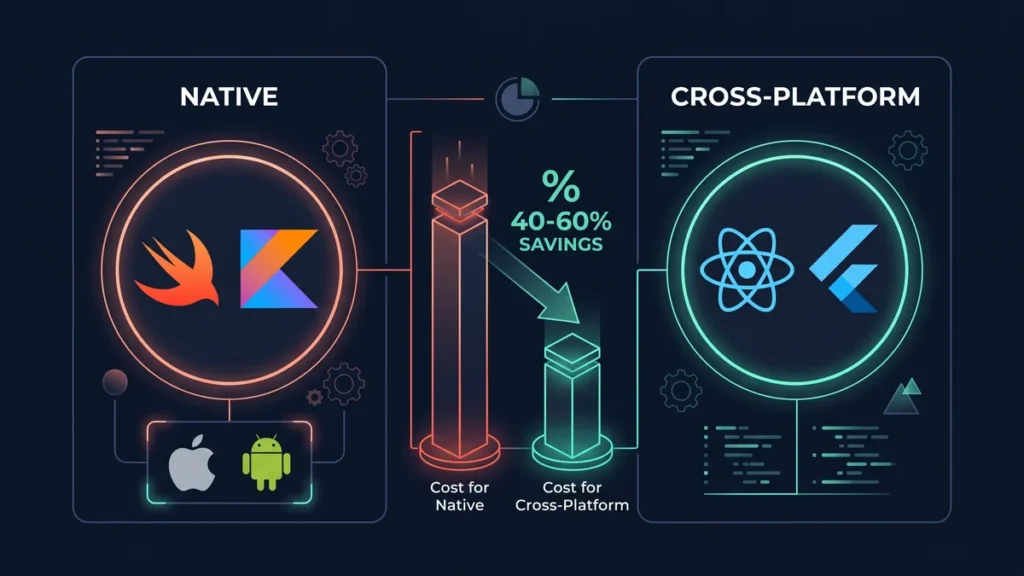
The cost difference is not marginal — it’s typically 40–60% cheaper to build and maintain a cross-platform app vs two native apps at equivalent quality levels.
When Native Is the Right Choice
Despite the cost premium, native development is clearly the right choice in specific scenarios:
Performance-critical applications
- High-performance games or graphics-intensive experiences
- Real-time video processing (AR filters, video editing)
- Advanced ML/AI on-device inference
- Apps where 1–2ms startup time difference is business-critical
Deep platform integration
- Apps using cutting-edge iOS APIs the day Apple releases them (HealthKit, ARKit, CarPlay)
- Apps requiring tight integration with Apple Watch or Android Wear
- Enterprise apps needing specific MDM or device management APIs
Large established teams
- Companies with existing iOS and Android teams who are highly productive
- Where the cost of migrating expertise outweighs the cost savings of cross-platform
Brand-defining UI
- Apps where the UI is the product differentiation (social media, consumer entertainment)
- Apps that need to feel native to be trusted by users (banking, healthcare on specific platforms)
When Cross-Platform is the Right Choice
Cross-platform wins for most business applications:
Business and enterprise applications
- Field service apps, logistics tracking, sales force automation
- Internal tools and workflows
- CRM, inventory management, attendance tracking
- Any app where functionality matters more than UI distinctiveness
Budget-conscious projects
- Startups building MVPs — get to market with one team
- SMBs that can’t justify two native development teams
- Projects where the ROI needs to be proven before deeper investment
Web + mobile together
- React Native shares code and team knowledge with React web apps
- One full-stack team can handle web and mobile
The Indian Market Context
Several India-specific factors push the calculus toward cross-platform:
Android dominance: India’s smartphone market is 95%+ Android by volume. Many B2B apps can start Android-only and add iOS later. Cross-platform makes the iOS addition cheaper when needed.
Device diversity: Indian users span from flagship devices to ₹8,000 Android phones. Cross-platform frameworks (particularly Flutter with Impeller) have improved dramatically on low-end hardware.
Developer availability: React Native JavaScript developers are more plentiful in Indian cities than Swift/Kotlin specialists. Cross-platform often means a larger available hiring pool.
Budget constraints: Indian SME clients building their first app often can’t justify native development costs. Cross-platform enables projects that wouldn’t otherwise be viable.
What the Major Indian Apps Use
| App | Approach |
|---|---|
| Swiggy | React Native (partially) |
| Zepto | React Native |
| CRED | Native (brand-defining UI) |
| PhonePe | Native (financial trust) |
| Meesho | React Native |
| ShareChat | Native + some RN |
| Nykaa | React Native |
Pattern: consumer-facing brand apps where UI is the product go native. Business-efficiency and commerce apps go React Native.
The Decision Framework
Answer these five questions:
- Is your app’s competitive advantage in its UI? (Yes = consider native, No = cross-platform is fine)
- Do you need cutting-edge platform features immediately on release? (Yes = native, No = cross-platform)
- What’s your budget? (<₹15 lakhs = cross-platform strongly favored, >₹25 lakhs = native is viable)
- Does your team already know Swift/Kotlin? (Yes = native may be cheaper for you specifically, No = cross-platform)
- Are you also building a web app? (Yes = React Native, No = either works)
If you answered “No / cross-platform” to 3+ questions: choose React Native or Flutter. If you answered “Yes / native” to 3+: native is probably right. If it’s split: cross-platform wins on cost, native wins on capability.
If you’re making this decision for your next mobile project and want an honest assessment of your specific situation, our mobile team at Softcrony builds both native and cross-platform apps for Indian clients.
Leave a comment