
🕮7 min read · 1,308 words
Every Indian software team I’ve talked to in the last year has some version of the same story. A system built in a hurry 3–5 years ago, now running the business, now impossible to change without breaking things, now requiring 60% of developer time just to keep working.
Technical debt is not abstract. It has a real cost, it accumulates in predictable ways, and it can be paid down deliberately. This is how to think about it.
What Technical Debt Actually Is
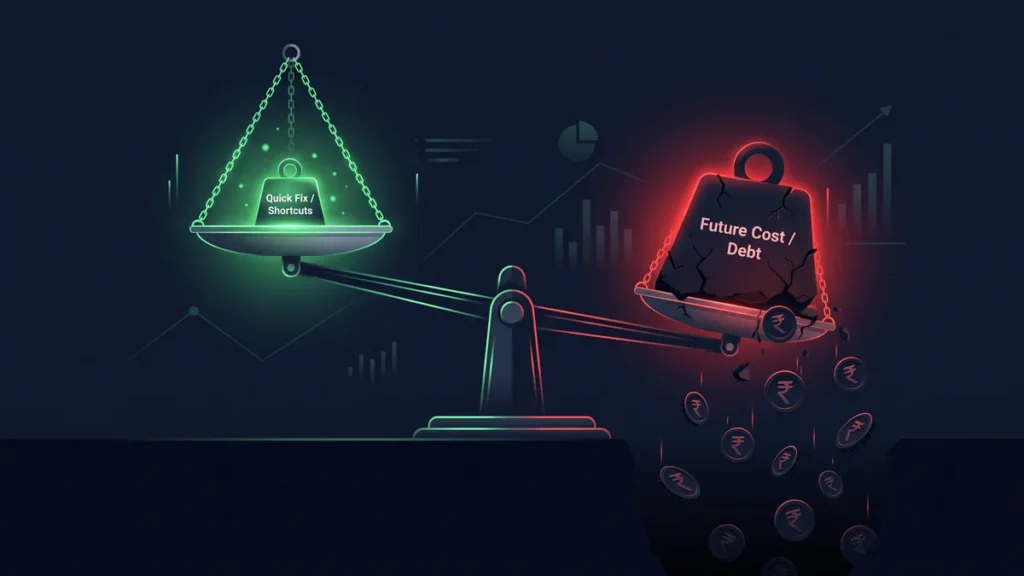
Ward Cunningham coined the term in 1992. The metaphor is exact: just like financial debt, technical debt represents work you chose not to do now that you’ll have to do later — with interest.
You take on technical debt when you:
- Skip writing tests because of deadline pressure
- Copy-paste code instead of building a reusable function
- Use a quick workaround instead of fixing the root cause
- Don’t document how a complex system works
- Keep a dependency that’s 4 major versions behind because “upgrading might break things”
- Build tightly coupled components because it was faster than designing proper interfaces
The interest on this debt is paid every time someone touches that code — slower development, more bugs, longer onboarding for new team members, higher risk in every deployment.
The Indian Context
Technical debt accumulates faster in certain environments, and Indian software development has specific factors that drive it:
Delivery pressure is extreme. Indian software projects — whether for domestic clients or for international delivery — operate under tight timelines. “We’ll fix it after the launch” is said sincerely and genuinely believed. The launch happens. The fix doesn’t.
High developer turnover. The Indian developer market is mobile. Developers move between companies every 1–2 years. The person who knows why a piece of code works the way it does leaves. The knowledge goes with them. What’s left is code that works but nobody fully understands.
Budget constraints lead to under-investment in quality. Indian SME clients often can’t or won’t budget for proper testing, documentation, and refactoring. Agencies under price pressure cut corners. The client pays the hidden cost later — in bugs, in slow development velocity, in systems that break when one person leaves.
Legacy systems that “work.” A system built in PHP 5.6 in 2014 that runs the business is very hard to justify replacing when it’s “working.” The cost of the debt is invisible until it isn’t — until a security breach, a major bug, or an inability to add a feature that competitors have had for two years.
The Compound Interest Problem
This is the most important thing to understand about technical debt: it compounds.
In the first year after a shortcut, the cost is small. A developer spends an extra hour figuring out the code each time they touch it. A bug gets introduced that takes a day to track down. Small friction.
In year three, that same shortcut is a core assumption that 15 other pieces of code depend on. Changing it requires touching dozens of files. Every developer who joins the team needs three weeks to understand this particular system’s quirks. Bugs in this area are the hardest to debug. Features that should take a week take three.
In year five, nobody changes this code anymore unless they have to. A dedicated team member exists primarily to manage the consequences of decisions made in 2021. New developers are told “don’t touch that” on their first day.
How to Measure Technical Debt
You can’t manage what you can’t measure. Here’s a practical framework:
1. Code Complexity Metrics
# PHP — run PHPMetrics on your Laravel codebase
composer require phpmetrics/phpmetrics --dev
vendor/bin/phpmetrics --report-html=reports/metrics.html app/

# Look for:
# - Cyclomatic Complexity > 10 (any single method)
# - Maintainability Index < 65 (files that need refactoring)
# - Average Lines per Method > 30 (methods doing too much)
# JavaScript — run complexity analysis
npx es6-plato -r -d reports src/
# Or with ESLint complexity rule
# .eslintrc.js
rules: {
'complexity': ['warn', { max: 10 }],
'max-lines-per-function': ['warn', { max: 50 }],
}2. Test Coverage
# Laravel — check test coverage
php artisan test --coverage

# Target: above 70% for business-critical code
# Below 40% is a debt signal worth addressing
3. Dependency Health
# Check for outdated PHP packages
composer outdated

# Check for security vulnerabilities
composer audit

# Check for outdated npm packages
npm outdated
npm audit
4. The “Bus Factor”
How many developers need to be “hit by a bus” for a piece of the system to become unmaintainable? If the answer is “one” — you have a debt problem, regardless of code quality.
# Git — find code with very few contributors
git log --follow --pretty=format:"%an" app/Services/PaymentService.php | \
  sort | uniq -c | sort -rn

# If only 1-2 names appear — critical knowledge dependency
The Cost in Real Numbers
Academic research on technical debt gives us some concrete numbers to work with:
- Developers spend approximately 23% of their time dealing with technical debt (Microsoft Research, 2016 — still reflective of current reality)
- High-debt codebases take 2–4x longer to add new features than comparable low-debt codebases
- Bug rates are 3–6x higher in high-complexity code vs low-complexity code
- Developer onboarding time increases 40–60% for every additional year of accumulated debt
Translating to Indian rates:
| Team Size | Avg Dev Cost/Month | 23% Debt Tax | Annual Debt Cost |
|---|---|---|---|
| 3 developers | ₹1,50,000/month | ₹34,500/month | ₹4,14,000/year |
| 5 developers | ₹2,50,000/month | ₹57,500/month | ₹6,90,000/year |
| 10 developers | ₹5,00,000/month | ₹1,15,000/month | ₹13,80,000/year |
That’s the cost before you account for slower feature delivery, higher bug rates, and the talent cost of developers who leave because they’re tired of working in a messy codebase.
How to Pay It Down
The classic mistake is trying to pay all the debt at once. A “big rewrite” that takes 6 months and delivers nothing while the business waits is rarely the answer. The better approach is systematic, incremental debt reduction.
The Boy Scout Rule
Leave every file better than you found it. When you touch a file for any reason, make one small improvement — extract a method, add a test for the thing you’re changing, update a comment that’s wrong. This doesn’t slow you down, and over months it meaningfully improves high-traffic code.
The Debt Register
Create and maintain a debt register — a simple list of known debt items with estimated remediation cost. Review it in sprint planning. Allocate 15–20% of sprint capacity to debt reduction. This makes debt visible and negotiable.
// Example debt register entry
{
  "id": "DEBT-042",
  "location": "app/Services/OrderService.php",
  "description": "God class — 800+ lines, handles 12 different responsibilities",
  "symptoms": "All order-related bugs traced here. Takes 4 hours to onboard devs on this file.",
  "estimated_effort": "3 days",
  "priority": "high",
  "owner": "backend team",
  "created": "2026-03-15"
}
Strangler Fig Pattern
For large legacy systems — replace piece by piece while the old system runs. We covered this in our case study on migrating a legacy PHP system to Laravel. The same pattern works for any large refactor. You don’t replace everything at once — you replace module by module, moving traffic from old to new incrementally.
Test Coverage as a Forcing Function
Set a rule: new features require tests. Existing code touched for any reason requires tests for the touched areas. Over time, test coverage grows around the active parts of the codebase — which are exactly the parts that need it most.
The Conversation with Clients
The hardest part of managing technical debt in an agency or consulting context is the client conversation. “We need to spend ₹3 lakhs to refactor code that already works” is a hard sell.
The framing that works: translate debt into business outcomes.
“This refactor will take 3 weeks and cost ₹3 lakhs. In exchange: every new feature you ask for going forward will take 40% less time to build. We will be able to add new payment methods in 2 days instead of 2 weeks. Bug rates in the order system will drop by approximately 60%. Your team will spend less time dealing with system problems and more time running the business.”
That’s a business decision, not a technical one. Good clients make it correctly.
If you’re dealing with a high-debt codebase and want a practical assessment of your options, our team at Softcrony has helped several clients work through this.
Leave a comment