
🕮9 min read · 1,631 words
Most Indian business owners know AI is important. They read about it every day. Their competitors are talking about it. Their clients are asking about it. But when it comes to actually doing something about it — where to start, what to build, what it costs, whether it’s even worth it for a business their size — the clarity disappears.
This post is the honest, practical answer to that question. Not theoretical. Not written for a Fortune 500 company. Written specifically for Indian businesses — manufacturers, service firms, ecommerce stores, healthcare providers, logistics companies — that are trying to figure out what AI actually means for them in 2026.
What AI Integration Actually Means for a Business
AI integration doesn’t mean replacing your entire team with robots or spending crores on technology. For most Indian businesses, it means something far more practical — automating specific tasks that currently consume time, making better use of data you already have, or building tools that help your team work faster and make fewer errors.
A factory in Nagpur using AI to predict equipment failures before they happen. A logistics company in Delhi using AI to optimise delivery routes in real time. A clinic in Pune using an AI chatbot to handle appointment bookings at 11pm. A retail chain in Bangalore using AI to forecast which products to stock before a festive season.
None of these require a complete business transformation. All of them started with one specific problem that AI was well-suited to solve.
The Right Question to Start With
Before thinking about technology, ask one question: what is wasting the most time or costing the most money in your business right now?
The answer is almost always where AI should start. Not where it’s most impressive or most talked about — where it solves a real, painful, expensive problem that you’re dealing with today.
For most Indian SMBs, the honest answers to that question fall into a few recurring categories. Customer queries that repeat endlessly. Manual data entry across systems that don’t talk to each other. Reports that take hours to compile. Sales follow-ups that fall through the cracks. Inventory decisions made on gut feel rather than data.
Each of these is an AI opportunity. And each of them is solvable at a cost that makes sense for a mid-sized Indian business.
Where AI Delivers Real Impact — Indian Business Context
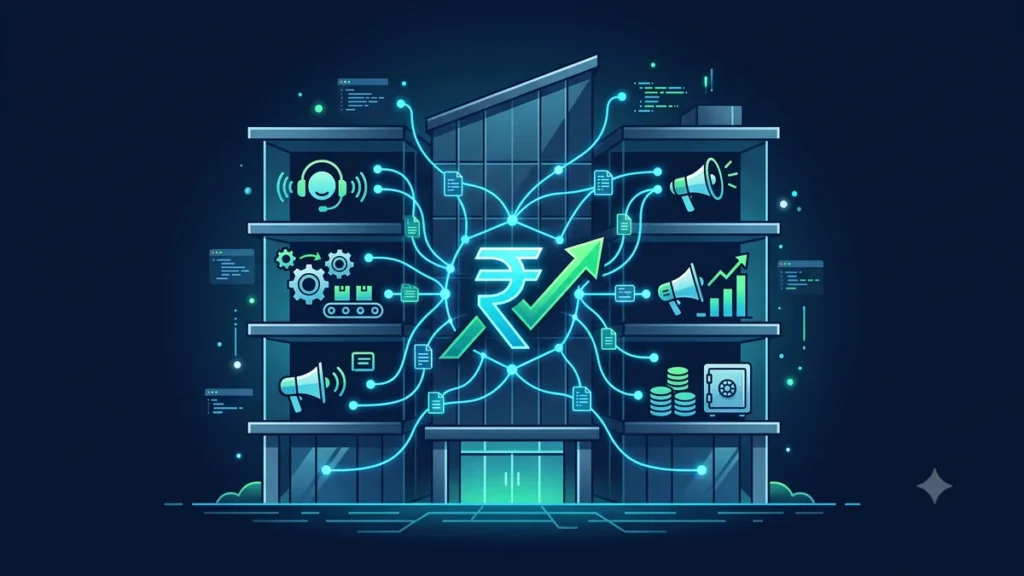
Customer support and inquiry handling is where most Indian businesses start — and for good reason. Indian businesses deal with high volumes of repetitive customer queries across WhatsApp, email, and phone. The same questions, answered manually, hundreds of times a month. An AI chatbot or automated response system handles the repetitive 70–80% of queries instantly, at any hour, in Hindi or English, while human staff focus on the complex cases that genuinely need attention.
For Indian ecommerce businesses, this is particularly valuable during sale seasons — Diwali, end-of-season sales — when query volumes spike dramatically and support teams get overwhelmed.
Sales process automation is where Indian B2B businesses leave the most money on the table. Most Indian sales teams spend enormous time on CRM updates, follow-up reminders, lead qualification, and proposal generation — tasks that AI can handle automatically. Tools that score leads based on behavior, send timely follow-up messages, and flag high-priority prospects allow sales teams to focus on conversations that actually close deals.
Operations and workflow automation has the highest ROI for Indian manufacturing, logistics, and service businesses. Approval workflows that currently involve five WhatsApp messages and three phone calls can be fully automated. Purchase order processing, invoice matching, attendance and shift management, quality control checklists — these are operational tasks that AI automates reliably and without human error.
Inventory and demand forecasting is transforming Indian retail and manufacturing. Businesses that previously made stocking decisions based on experience and gut feel are now using AI models trained on their own sales data to predict demand by SKU, by season, by geography. The result is less overstock, fewer stockouts, and significant reduction in working capital tied up in slow-moving inventory.
Document processing is one of the most underestimated AI opportunities for Indian businesses. Invoices, purchase orders, GST filings, compliance documents, contracts — Indian businesses generate enormous paper and PDF volumes. AI can extract data from documents automatically, classify them, route them for approval, and flag discrepancies. What currently takes hours of manual data entry becomes a background process that runs without human involvement.
Marketing personalisation and analytics gives Indian businesses the ability to act on data they already have but rarely use. Most businesses have months or years of customer transaction data sitting in their CRM or ERP. AI can identify patterns in that data — which customers are likely to churn, which products sell together, which customer segments respond to which offers — and turn those insights into actions without a dedicated data science team.
Real Costs for Indian Businesses in 2026
This is where most guides get vague. Let’s be specific about what AI implementation actually costs for Indian businesses at different levels.
Entry level — ₹5,000 to ₹20,000 per month
Off-the-shelf AI tools with no custom development. This includes AI chatbot platforms like Tidio, Freshchat, or Intercom for customer support, AI writing assistants for content and email, basic automation tools like Zapier or Make for connecting existing software, and AI features built into tools you already use — Gmail Smart Reply, Notion AI, Zoho AI. These require minimal technical expertise to set up and deliver immediate productivity improvements.
Mid level — ₹50,000 to ₹3,00,000 one-time build cost + ₹5,000 to ₹20,000 per month running cost
Custom AI features built for your specific business needs. A chatbot trained on your product catalogue and FAQs. An AI model integrated with your existing ERP or CRM. Automated document processing for your invoice or purchase order workflows. Custom sales automation connected to your lead sources. This level requires a development partner and typically takes four to twelve weeks to build. The running cost is primarily API costs — GPT-4 or Claude API — which scale with usage.
Advanced level — ₹3,00,000 to ₹20,00,000+ build cost
Custom AI systems built for complex, high-volume business problems. Predictive maintenance systems for manufacturing. Full AI-powered demand forecasting integrated with supply chain. Multi-language, multi-channel customer intelligence platforms. These are typically justified when the problem is expensive enough — recurring losses, significant manual headcount, or competitive disadvantage — that the investment pays back within twelve to eighteen months.
The honest calculation for any AI project: what is the current problem costing you per year in staff time, errors, lost sales, or operational inefficiency? If the AI solution costs less than one year of that problem, the investment is straightforward.
What Indian Businesses Get Wrong About AI
Trying to do everything at once is the most common mistake. A business decides to “implement AI” and simultaneously tries to automate customer support, sales, operations, and reporting. Nothing gets done properly, results are disappointing, and the conclusion is that AI doesn’t work. It does work — but only when applied to a specific, well-defined problem with a clear metric for success.
Buying technology before understanding the problem is the second most common mistake. Platforms, tools, and subscriptions get purchased based on demos and promises. Six months later, the tool sits unused because it doesn’t quite fit how the business actually works. The sequence should always be: define the problem clearly, then find or build the right solution.
Underestimating change management is where many technically successful AI projects fail commercially. The technology works perfectly but the team doesn’t use it because no one explained why it was being introduced, how it changes their workflow, or what they should do differently. AI adoption is as much a people problem as a technology problem.
A Practical Starting Point for Indian SMBs
The businesses that get the best results from AI don’t start with a strategy document or a technology evaluation. They start with a one-week audit of where time is actually going in their business.
Ask your team to track, for one week, how much time they spend on tasks that feel repetitive — tasks where they’re doing the same thing they did yesterday, or last week, or last month. Compile those estimates. Identify the top three time sinks by total hours per week across your team.
Those three things are your AI roadmap. Start with the biggest one. Build or implement a solution specifically for that problem. Measure the time saved and the error reduction. Use that result to build the business case for the next initiative.
This approach works for a ten-person business and a five-hundred-person business. It produces results in weeks rather than months and builds confidence in AI across your team based on real outcomes rather than promises.
Is Now the Right Time for Indian Businesses to Invest in AI?
The honest answer is yes — with a caveat. The right time to invest is when you have a specific problem that AI solves, a realistic budget to build or implement a proper solution, and the internal willingness to actually use it.
AI for its own sake produces nothing. AI applied to a real operational problem produces measurable results quickly. Indian businesses that are making this shift thoughtfully — starting small, measuring carefully, and expanding based on results — are building operational advantages that will be difficult for competitors to replicate in three to five years.
The businesses waiting until AI is “proven” are making the same mistake businesses made in 2010 when they delayed building websites because the internet wasn’t mainstream enough. By the time it’s obvious, the early movers have already won.
If you want to identify where AI could make the biggest difference in your specific business — and what it would realistically cost to build — our team at Softcrony is happy to help. We work with Indian businesses across manufacturing, logistics, healthcare, retail, and professional services to build AI solutions that solve real problems and deliver measurable returns.
Leave a comment