
🕮12 min read · 2,384 words
Ten years ago, building a proper brand required a branding agency, a graphic designer, a copywriter, and a budget that most startups and small businesses simply didn’t have. You either paid for professional branding or you launched with something cobbled together that quietly communicated “we’re not serious yet.”
That equation has changed completely. AI tools have made professional-quality brand building accessible to any business willing to invest time and intention — not necessarily a large budget. The output won’t replace a world-class branding agency for a company that can afford one. But for the vast majority of startups and SMBs, AI-assisted branding produces results that are significantly better than what was previously achievable without significant spend.
This guide covers the full branding process — from brand strategy through visual identity through voice and content — and where AI tools fit into each stage, what they do well, and where human judgment still matters.
What Branding Actually Is — Before the AI Part
Branding gets confused with logo design constantly. A logo is one small component of a brand. A brand is the complete set of associations, feelings, and expectations that someone has when they encounter your business — what you stand for, who you serve, how you communicate, what you look like, how you’re different from competitors, and why someone should trust you over alternatives.
Getting this foundation right before touching any design tool — AI-powered or otherwise — is the difference between branding that works and branding that looks professional but doesn’t mean anything. AI tools are most powerful when they’re working from a clear brand foundation. Applied without that foundation, they produce generic, interchangeable output that looks fine but builds nothing.
So the process starts with strategy — not software.
Stage 1 — Brand Strategy with AI
Brand strategy answers the foundational questions: who are you, who do you serve, what problem do you solve, how are you different, and what do you stand for? Traditionally, this required workshops with a brand strategist, customer research, and competitive analysis. AI dramatically accelerates this process — not by replacing the thinking, but by structuring it and challenging your assumptions.
Start by using Claude or ChatGPT as a brand strategy thinking partner. Give it the context of your business — what you do, who your customers are, your competitors, your market — and work through these questions with it:
Positioning: What specific problem do you solve better than anyone else, for a specific type of customer? Prompt the AI to identify three to five positioning options and argue for and against each. Push it to be specific — “we’re better than competitors” is not positioning. “We’re the only logistics management system built specifically for Indian Tier 2 city distribution networks” is positioning.
Brand personality: If your brand were a person, how would they speak, dress, and behave? Prompt the AI to develop five to six personality dimensions — where you sit on spectrums like formal/casual, serious/playful, expert/accessible, traditional/modern. These personality dimensions will inform everything from your visual identity to your copywriting tone.
Value proposition: One clear sentence that tells your target customer exactly what you do, for whom, and why it matters. Ask the AI to generate ten variations, then critique each one with you. Most will be generic — the process of rejecting them and explaining why sharpens your thinking toward what’s actually true and distinctive about your business.
Competitive differentiation: Ask the AI to analyse your competitors — give it their website URLs, their taglines, their positioning — and identify the gaps. Where is there white space in how the market is positioned? What attributes are no competitor currently owning? This analysis is faster and more comprehensive with AI than without it.
The output of this stage is a one-page brand brief: your positioning statement, your target customer description, your personality dimensions, your core values, and your key differentiators. Every subsequent branding decision references this brief.
Stage 2 — Brand Name and Tagline
If you’re naming a new product, sub-brand, or service line — AI is genuinely useful here, though it requires significant curation. The AI generates volume; you provide judgment.
Give the AI your brand brief and ask it to generate name options across different naming strategies: descriptive names that communicate what you do, invented names with no prior meaning, combination names that blend two relevant concepts, metaphorical names that evoke a feeling or idea associated with your brand. Ask for twenty to thirty options across these categories.
Then filter ruthlessly. Check domain availability. Check trademark databases. Say each name out loud. Consider how it sounds in Hindi and regional languages if you’re targeting Indian markets — some English words have unintended meanings or awkward pronunciations in Indian languages that a purely English-language AI won’t flag.
For taglines, give the AI your positioning statement and personality dimensions and ask for twenty variations across different tones — functional, emotional, aspirational, provocative, simple. Taglines that survive the test of time tend to be short, specific, and true. Reject anything that could apply to any competitor without changing a word.
Stage 3 — Visual Identity with AI Tools
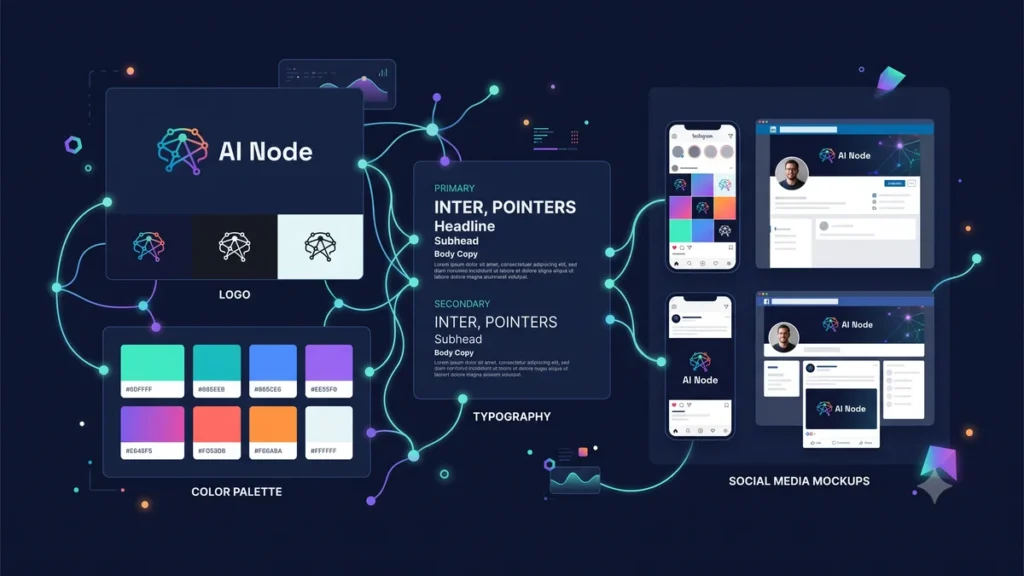
This is where AI tools have made the most dramatic difference for small businesses and startups. Professional visual identity — logo, colour palette, typography, design system — previously required a skilled graphic designer. AI tools have changed what’s possible without one, though the best results still come from combining AI with design judgment.
Logo creation using AI image generation tools like Midjourney, Adobe Firefly, or DALL-E has become viable for early-stage brands. The key is prompting with brand precision — not “make me a logo for a software company” but “minimal wordmark logo for a B2B logistics software brand, dark navy and electric blue colour palette, geometric sans-serif typography, clean and trustworthy, no gradients, suitable for both light and dark backgrounds.”
AI-generated logos require significant iteration and curation — most outputs need refinement, and many won’t be right. The useful outputs provide a starting direction that a designer can refine in vector format, or that you can use as a foundation for further AI iteration. Tools like Looka, Brandmark, and Turbologo use AI specifically for logo generation and produce vector-format outputs that are more immediately usable than image generators.
Colour palette selection with AI is highly effective. Tools like Coolors and Adobe Color use algorithmic generation, and Claude or ChatGPT can reason about colour psychology and brand alignment. Give the AI your brand personality dimensions and industry context and ask it to recommend a primary colour with reasoning, then build the palette from there. The reasoning matters — understanding why a colour fits your brand helps you evaluate options rather than just picking what looks nice.
For Indian brands targeting domestic markets, consider that colour associations differ from Western conventions. White is associated with mourning in some Indian contexts. Saffron has strong religious and political connotations. Green has positive associations across most of India. These nuances are worth explicitly discussing with the AI — it knows them if you ask.
Typography selection follows from personality. AI tools can recommend typeface pairings based on brand personality, and tools like Fontjoy and Archetype generate pairing suggestions algorithmically. For most digital brands, two typefaces are sufficient — one for headings, one for body text. AI can help you understand the personality implications of different typeface categories: serif typefaces communicate tradition and authority, geometric sans-serifs communicate modernity and precision, humanist sans-serifs communicate approachability and warmth.
Brand design system creation — documenting how the visual elements work together, with usage rules and examples — is a task where AI tools like Canva’s Brand Kit, Figma with AI plugins, and dedicated brand tools like Frontify accelerate significantly. Documenting a brand system that previously took a designer several days can be done in hours with AI-assisted tools.
Stage 4 — Brand Voice and Messaging
Brand voice is how your brand sounds in written and spoken communication — the personality dimensions expressed through language. Consistent brand voice is what makes your website, your social media, your emails, and your sales materials feel like they come from the same place rather than from different people on different days.
AI is exceptionally useful for developing and maintaining brand voice, because language is where AI tools are strongest.
Start by developing a brand voice guide with AI assistance. Give it your personality dimensions and ask it to translate each into specific language guidelines — words to use, words to avoid, sentence length preferences, level of formality, how to handle technical jargon, how to communicate pricing and value. Ask it to write the same piece of content — a product description, a company introduction — in five different voices, from most formal to most casual, and identify which fits your brand personality best.
Once you have a voice guide, AI becomes a powerful tool for maintaining consistency at scale. Feed the voice guide into Claude or ChatGPT as a system prompt and use it to generate on-brand first drafts of website copy, social media posts, email sequences, and sales materials. The AI applies the voice guide consistently — something that’s difficult to maintain when multiple people are writing for the brand.
Key messaging — the specific claims, proof points, and narratives that you use repeatedly across all communications — can also be developed with AI. Give it your positioning, your customer pain points, your differentiators, and your proof points and ask it to develop a messaging hierarchy: the headline claim, the supporting messages for each key audience segment, the specific proof points that validate each claim. This structured messaging framework ensures that everyone speaking for the brand — sales team, marketing, founders — is telling the same story.
Stage 5 — Brand Content at Scale
One of the most practical advantages of AI for brand building is the ability to create consistent, on-brand content at a volume that was previously impossible without a large content team.
Social media content — the most time-consuming ongoing brand-building activity for most businesses — becomes manageable with AI assistance. A monthly content calendar that would previously take a marketing team several days to plan and write can be generated in hours. The key is giving the AI enough brand context — your voice guide, your target audience, your content pillars — that the output genuinely represents your brand rather than generic industry content.
Website copy, case studies, email sequences, sales decks, and product descriptions all benefit from AI assistance when the brand foundation is clear. The AI produces on-brand first drafts that require editing and refinement rather than starting from a blank page — which is where most of the time and cost in content creation is spent.
For Indian businesses, AI can also assist with multilingual brand content — translating and adapting brand voice for Hindi and regional language communications. The quality of AI translation has improved dramatically, though human review for nuance and cultural appropriateness remains important for brand-critical content.
Stage 6 — Brand Application Across Digital Touchpoints
A brand exists across multiple touchpoints — website, social media profiles, email signatures, presentations, proposals, business cards, packaging. Consistency across all of these is what builds brand recognition over time. AI tools make this consistency easier to achieve.
Canva’s Brand Kit and similar tools let you define your brand colours, fonts, and logo and apply them automatically across templates. This means any team member creating a social media post, a presentation, or a document is working within brand guidelines without needing design expertise.
AI tools like Relume and Framer AI can generate on-brand website designs from a brief — useful for early-stage brands that need a credible web presence quickly. The output requires refinement but provides a stronger starting point than a blank canvas.
For social media profile consistency — profile photos, cover images, highlight covers, post templates — AI image generation combined with brand guidelines produces consistent visual identity across platforms faster than manual design.
What AI Cannot Do for Your Brand
Honest assessment matters here. AI tools are powerful brand-building accelerators. They’re not a replacement for the things that make brands genuinely strong.
AI cannot give your brand authenticity. A brand built entirely on AI-generated content, AI-generated visuals, and AI-developed strategy risks being technically correct but emotionally hollow — it looks like a brand without feeling like one. The human story behind your business, the genuine reason you built what you built, the specific way your team thinks about problems — these are things AI can help you articulate, but they have to actually exist first.
AI cannot build trust on your behalf. Trust is built through consistent delivery over time — keeping promises, producing quality work, being honest when things go wrong. No amount of AI-generated brand content substitutes for this. Branding amplifies trust; it doesn’t create it.
AI cannot replace deep customer understanding. AI tools can help you analyse customer data and identify patterns, but the qualitative understanding of what your customers actually care about, how they think about their problems, and what would genuinely make their lives better comes from real conversations and real observation. This understanding is the raw material that good branding translates into communication. Without it, AI produces generic outputs that speak to nobody in particular.
Getting Started — The Practical First Steps
If you’re starting from scratch or refreshing an existing brand, the sequence matters. Strategy before visuals. Visuals before content. Content before distribution.
Start this week with a brand strategy session using Claude or ChatGPT — an hour of focused conversation working through positioning, personality, and differentiation. Write down what emerges as a one-page brand brief. Everything else — name, logo, colours, voice, content — flows from that brief.
The businesses that use AI most effectively for branding are the ones that treat it as a thinking partner and a production accelerator, not as a replacement for strategic clarity. AI will gladly generate a logo, a tagline, and a month of social content for a brand with no clear positioning. The output will look professional and mean nothing.
Give AI a clear brief. Use it to generate, iterate, and scale. Apply your own judgment to select, refine, and make it true. That combination — AI’s speed and scale, human judgment and authenticity — produces brands that are both efficiently built and genuinely effective.
If you’re building a brand for a new product or business and want help developing the strategy and digital presence that underpins it, our team at Softcrony is happy to help. We work with startups and growing businesses across India to build digital brands that attract the right customers and communicate the right things.
Leave a comment