
🕮7 min read · 1,393 words
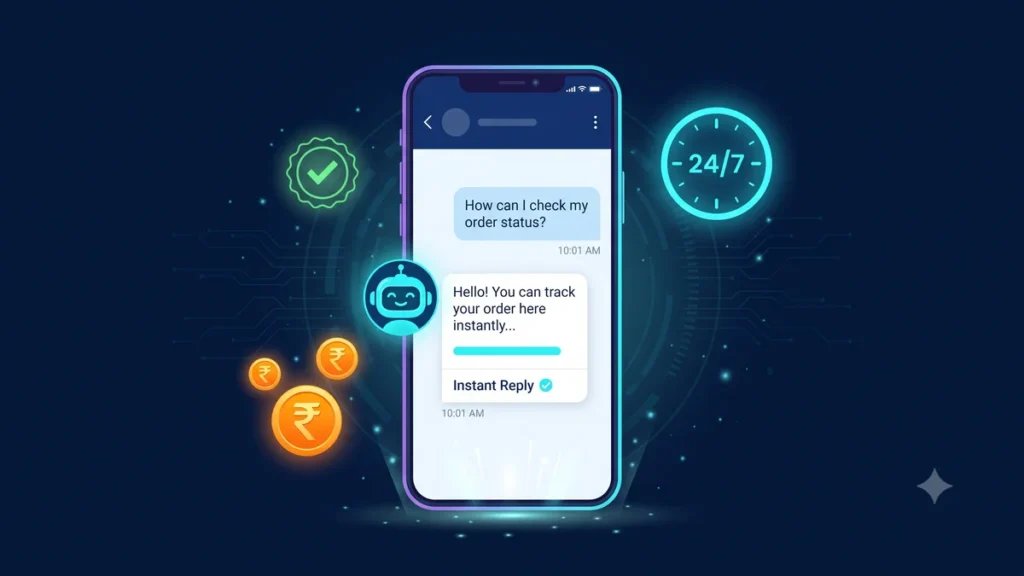
A customer messages a business at 11pm asking about delivery status. In the old model, they get a response the next morning — if they’re lucky. In the new model, they get an accurate, helpful response in three seconds. No human involved. No delay. No missed opportunity.
This is what AI chatbots are doing for Indian businesses in 2026 — and the gap between businesses that have made this shift and those still running on WhatsApp messages and phone calls is widening every month.
This isn’t about replacing people for the sake of cutting costs. It’s about meeting customer expectations that have fundamentally changed — and doing it in a way that’s actually affordable for Indian businesses of every size.
Why Customer Support Is Broken for Most Indian SMBs
Most Indian small and medium businesses handle customer support the same way they did ten years ago. A phone number, a WhatsApp contact, maybe an email address. Responses happen when someone is available. Queries get missed. Follow-ups fall through the cracks. The same questions get answered manually hundreds of times a month.
This model has three problems that compound as a business grows. It doesn’t scale — every new customer adds to the support load linearly. It’s inconsistent — the quality of response depends entirely on who answers and when. And it’s expensive relative to the value it delivers — a significant portion of support time is spent answering repetitive questions that could be automated.
For Indian businesses competing in categories where customer experience is a differentiator — ecommerce, healthcare, financial services, real estate, education, SaaS — this broken support model is actively costing them customers and reputation.
What’s Changed That Makes AI Chatbots Actually Work Now
AI chatbots have existed for years but the early versions were frustrating — rigid decision trees that couldn’t handle anything outside a narrow script. Customers hated them. Businesses quietly abandoned them.
What’s changed in the last two years is the quality of the underlying AI. Large language models — the same technology behind ChatGPT and Claude — can now understand natural language questions, handle ambiguous queries, maintain context across a conversation, and generate responses that feel genuinely helpful rather than robotic.
A modern AI chatbot doesn’t follow a decision tree. It understands what a customer is asking, even when it’s phrased in Hindi, in broken English, or in an unusual way, and responds with accurate, contextually appropriate information. The gap between a good AI chatbot response and a human response has narrowed dramatically — and in many cases, the AI is faster, more consistent, and more accurate.
What Indian Businesses Are Using AI Chatbots For
The most common use cases for AI chatbots in Indian businesses right now fall into a few clear categories.
Order and delivery queries are the highest volume support category for Indian ecommerce businesses. “Where is my order?” “When will it arrive?” “Can I change my delivery address?” These queries are repetitive, time-sensitive, and perfectly suited to AI automation. A chatbot connected to your order management system can answer these instantly and accurately at any hour.
Product and service information — pricing, specifications, availability, eligibility — accounts for a large portion of pre-purchase queries. An AI chatbot that knows your product catalogue or service offerings can answer these questions instantly and move buyers closer to a decision without waiting for a human sales rep to become available.
Appointment booking and lead qualification are transforming how Indian service businesses — clinics, consultants, real estate agents, financial advisors — handle inbound inquiries. Instead of a back-and-forth of missed calls and WhatsApp messages, an AI chatbot qualifies the lead, collects the necessary information, and books an appointment automatically.
Complaint registration and escalation is where AI chatbots reduce pressure on human support teams most effectively. The chatbot handles the initial registration, collects all relevant details, provides an acknowledgement and timeline, and escalates to a human only when genuinely needed. Human agents spend their time on complex issues rather than data collection.
Multilingual support is a significant advantage for Indian businesses serving customers across different states. A well-implemented AI chatbot can handle queries in Hindi, English, and major regional languages simultaneously — something a human support team can only do with significant investment in hiring.
The Cost Reality for Indian Businesses
One of the biggest misconceptions about AI chatbots is that they’re expensive — something only large enterprises can afford. This was true three years ago. It’s not true in 2026.
There are broadly three cost tiers for Indian businesses looking at AI chatbot implementation.
At the entry level, platforms like Tidio, Freshchat, and Intercom offer AI-powered chat with reasonable free tiers and paid plans starting at ₹1,500–3,000 per month. These work well for businesses with straightforward support needs and moderate query volumes. Setup can be done in a few days without custom development.
At the mid level, a custom AI chatbot built on GPT-4 or Claude APIs, integrated with your existing systems — CRM, order management, booking system — costs ₹40,000–1,50,000 to build and ₹5,000–15,000 per month to run. This delivers a significantly better experience than off-the-shelf tools because it’s trained on your specific business data and integrated with your workflows.
At the enterprise level, fully custom AI support systems with advanced integrations, voice support, and multilingual capabilities are built for larger businesses with complex support operations. These start at ₹3,00,000+ for development and are typically justified when the volume of support queries is high enough that the savings in human support costs pay for the investment within six to twelve months.
For most Indian SMBs, the mid-level option delivers the best balance of capability and cost — and the ROI calculation is straightforward. If you’re currently paying three support staff ₹15,000–20,000 per month each, a custom AI chatbot that handles 70–80% of their current workload pays for itself in the first month.
What AI Chatbots Cannot Replace
Honest answer — not everything. AI chatbots are excellent at handling high-volume, repetitive, information-based queries. They are not good at handling emotionally complex situations, at making judgment calls that require deep business context, or at building the kind of relationship that comes from genuine human conversation.
A customer who is angry about a damaged product, a client who is confused about a complex service contract, a patient asking about a sensitive medical situation — these interactions still need a human. The best implementations of AI chatbots in Indian businesses use a hybrid model: the AI handles everything it can handle well, and escalates seamlessly to a human when the situation requires it.
The goal isn’t to eliminate your support team. It’s to let them focus on the interactions where a human genuinely makes a difference — and let the AI handle everything else.
How to Know If Your Business Is Ready for an AI Chatbot
Three questions help answer this. First, how many of your current support queries are repetitive — the same questions asked over and over? If more than 50% of your support volume is repetitive, AI automation will have a significant impact. Second, what is the cost of your current support operation, and what would a 60–70% reduction in repetitive query volume save you? Third, how often do customers contact you outside business hours and get no response? Every unanswered query is a potential customer lost.
If your answers reveal significant repetitive query volume, meaningful support costs, and gaps in after-hours availability — an AI chatbot is not a luxury. It’s a competitive necessity.
Getting Started Without Getting It Wrong
The businesses that get the most value from AI chatbots start with a clear audit of their current support queries. Pull three months of support tickets, WhatsApp messages, or call logs and categorise them. Identify the top ten to fifteen query types by volume. These become the first use cases for your AI chatbot — the highest-impact, easiest-to-automate queries that deliver immediate ROI.
Don’t try to automate everything at once. Start with the highest-volume, most repetitive queries. Get those working well. Measure the impact. Then expand to the next tier of use cases. Businesses that try to build a chatbot that handles everything from day one usually end up with something that handles nothing well.
If you want to explore what an AI chatbot could do for your specific business — whether it’s a custom build integrated with your systems or a faster implementation using existing platforms — our team at Softcrony is happy to walk you through the options. We’ve built AI-powered support systems for Indian businesses across ecommerce, healthcare, logistics, and professional services.
Leave a comment