
🕮7 min read · 1,289 words
Two years ago, “AI in software development” meant GitHub Copilot suggesting the next line of code. Today it means AI agents that plan features, write tests, open pull requests, monitor production, and fix bugs — without a human touching the keyboard.
This isn’t science fiction. It’s what’s happening in engineering teams at companies like Cognition, Devin, and several large Indian IT services firms right now. And it’s splitting the industry into two camps: teams doing AI-assisted SDLC and teams building toward Agentic SDLC.
Understanding the difference isn’t optional anymore.
What Is AI-Assisted SDLC?
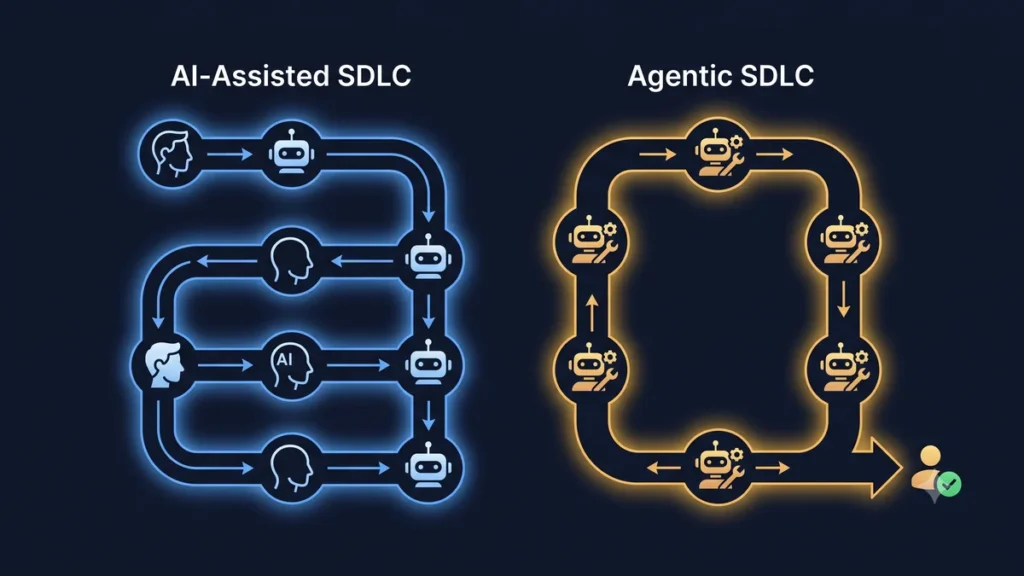
Most engineering teams in 2026 are here. AI tools are woven into the existing process — they make developers faster, but a human is still driving every decision.
The workflow looks like this:
- PM writes a requirement → developer reads it
- Developer asks Claude or Cursor to help design the solution
- AI generates code → developer reviews and edits
- Developer writes tests → AI helps with test cases
- Human reviews the PR → human deploys
- Human monitors production → human fixes bugs
The developer is still the brain. AI is the fast hands.
This model delivers real productivity gains — we’ve seen 2–4x velocity improvements in our own work at Softcrony. But the human is still the bottleneck. The process doesn’t fundamentally change — it just runs faster.
What Is Agentic SDLC?
Agentic SDLC removes the human from the implementation loop entirely. AI agents don’t just write code when asked — they independently plan, execute, verify, and ship.
The workflow looks like this:
- PM writes a requirement in natural language
- Orchestrator agent breaks it into subtasks
- Planning agent designs the technical approach
- Coding agent implements across multiple files
- Testing agent writes and runs tests
- Review agent checks for security and quality issues
- Deployment agent opens a PR, waits for CI, merges, deploys
- Monitoring agent watches production and creates a new task if something breaks
The human writes the requirement and approves the final PR. Everything in between is orchestrated AI.
This isn’t theoretical. Cognition’s Devin, GitHub’s Copilot Workspace, and Atlassian’s Rovo all work on versions of this model. Indian IT giants like Infosys and TCS have internal agentic engineering platforms already in limited deployment.
The Architecture of Agentic SDLC
Understanding how this works helps you see where it’s going:
Orchestrator Layer
A master agent receives the high-level requirement and coordinates all other agents. It maintains task state, handles failures, and decides when to escalate to a human. This is typically powered by a frontier model (Claude Opus, GPT-4o) with long context.
Specialist Agent Layer
Individual agents for specific tasks — each with its own system prompt, tools, and context:
- Planner agent: Reads requirements, codebase, and existing architecture. Produces a technical plan.
- Coder agent: Implements specific files and functions. Has access to file system tools.
- Tester agent: Writes unit and integration tests. Runs them. Iterates until passing.
- Reviewer agent: Checks for security vulnerabilities, code smells, and consistency with existing patterns.
- DevOps agent: Handles CI/CD, deployment configuration, and infrastructure changes.
Tool Layer
Agents need tools to actually do things — not just generate text:
- File system read/write
- Shell command execution
- Git operations (commit, push, PR creation)
- Browser (to test UI changes)
- API calls (to verify integrations)
- Database access (to validate schema changes)
Memory Layer
Agents need context that persists across tasks — the codebase structure, past decisions, architectural constraints, and team preferences. This is typically handled via:
- Vector database for codebase semantic search
- Structured memory for project decisions
- Git history as episodic memory
MCP — The Protocol Making This Possible
Model Context Protocol (MCP), released by Anthropic and now adopted across the industry, is the plumbing that makes Agentic SDLC practical.
MCP standardizes how AI models connect to external tools and data sources. Instead of every AI integration being custom-built, MCP creates a universal interface — any MCP-compatible tool can be plugged into any MCP-compatible AI model.
For software development, MCP servers exist for:
- GitHub — read/write repos, create PRs, comment on issues
- Jira / Linear — read tickets, update status, create subtasks
- Slack — read channels, send messages, post updates
- Databases — query, migrate, inspect schemas
- Terminal — run commands, read output
- Browser — navigate, click, screenshot
- Docker — manage containers and images
An agent with the right MCP tools can do in 10 minutes what a developer does in 2 hours — read the ticket, find the relevant code, make the change, write the test, open the PR, and ping the reviewer on Slack.
Where Indian Software Teams Stand in 2026
Honest assessment of where the Indian software industry is right now:
Large IT services (TCS, Infosys, Wipro, HCL): Actively deploying internal agentic platforms for repetitive development tasks. Early focus is on testing automation, code review, and documentation generation. Real productivity gains are happening — and headcount decisions are following.
Product startups: Most are at the AI-assisted stage. The ones moving fastest to agentic are those building AI products themselves — they understand the technology from the inside.
SME software companies (like Softcrony): AI-assisted workflows are standard. Agentic workflows are being evaluated. The transition will happen over the next 12–24 months as tooling matures and trust builds.
Freelancers and solo developers: Massive opportunity to punch above your weight class. A solo developer using AI-assisted workflows effectively can do the work of a 3-person team. A solo developer using agentic workflows effectively can do the work of a 5-person team.
What Changes for Developers
The honest answer — some things get worse and some get better.
Gets worse:
- Junior developer roles as “implement this feature” execution get squeezed. The agentic layer does that job.
- Repetitive coding work — CRUD, boilerplate, tests, documentation — gets automated. These skills are less valuable.
- Entry-level positions at large IT services companies will shrink over the next 3–5 years.
Gets better:
- Developers who can orchestrate and direct AI agents become extraordinarily productive.
- The gap between “can build an idea” and “has built an idea” shrinks dramatically. Solo developers can build products that previously required teams.
- System design, product thinking, and architectural judgment — things AI can’t do well — become more valuable.
- Developers who understand AI systems deeply (not just use them) are in extraordinary demand.
What to Learn Right Now
If you’re a developer wanting to stay relevant through this shift:
Learn prompt engineering properly. Not “how to ask ChatGPT questions” — actual structured prompting, system prompt design, chain-of-thought patterns, and output formatting. This is the skill that makes the difference between a developer who gets 2x from AI and one who gets 10x.
Build something with an AI agent. Set up a Claude MCP environment. Build one small agentic workflow — even something simple like “read my GitHub issues, assign complexity scores, and create a prioritized dev plan.” Understanding how agents work from the inside is irreplaceable.
Go deeper on system design. The higher up the abstraction stack you work, the longer before AI replaces that work. Architecture, scalability, product decisions — these require judgment about the real world that AI doesn’t have.
Develop business domain expertise. A developer who understands logistics, healthcare, or fintech at a business level is worth far more than one who only understands code. AI can write the code. It can’t understand why the business needs it.
The Bottom Line
AI-assisted SDLC is table stakes in 2026. If your team isn’t using AI tools in the development workflow, you’re already behind.
Agentic SDLC is where the next 3 years go. The developers and teams who understand it — who can orchestrate, evaluate, and direct AI agents — will have an enormous competitive advantage.
The most dangerous position is in the middle: using AI tools passively, treating them as autocomplete on steroids, without understanding the underlying shift. That’s where disruption is going to land hardest.
If you’re thinking about how AI fits into your development process or product roadmap, our team at Softcrony is navigating the same questions and happy to think through them with you.
Leave a comment